

Little Women is a reimagining of Louisa May Alcott’s famous story, set in modern-day Korea. The story follows three impoverished sisters who find themselves in conflict with the richest and most powerful family in the country. While the series is often praised for its plot and performances, its interiors also play a significant role in the storytelling. Here, luxury serves as a visual language that depicts relationships and power dynamics.
What’s striking is how the show’s most opulent spaces embrace a modern, globally familiar design language, incorporating modular seating, disciplined proportions, and an edited, European-influenced restraint reminiscent of brands such as Arflex. The effect is subtle yet deliberate. Little Women uses spaces that feel familiar to an international audience while remaining deeply tied to the story’s emotional architecture.
When Furniture Becomes a Social Status Barrier
In Little Women, architecture symbolizes authority. The wealthiest homes are defined by expansive living rooms, high ceilings, and layouts that discourage intimacy. These spaces control movement, and the furniture often acts as a barrier rather than a bridge, reinforcing who dominates the room.
This sense of control is amplified by the way rooms are organized around focal points rather than comfort. Seating arrangements rarely encourage closeness. Instead, they create distinctions between hosts and guests, observers and the observed. The house itself becomes a silent participant, shaping behavior and reinforcing social order.
When Materials Hold Back Feelings
Material choices intensify this atmosphere of restraint. Polished marble floors stretch across living areas, reflective surfaces remain cool, while dark woods and stone walls add visual weight, grounding spaces with a sense of permanence and inevitability. While these materials are associated with endurance and wealth, here they also suggest emotional containment.
Furniture finishes reflect that tension. Black leather appears frequently in key seating pieces, particularly large L-shaped sofas anchoring modern living rooms. Their angular configurations feel closed and defensive rather than open and welcoming. Smooth leather reinforces the idea of surfaces designed to withstand pressure rather than absorb it.
Furniture as Statement, Not Background Decor
The show’s approach to furniture is selective and assertive. Rather than layering multiple pieces, interiors rely on small strong elements that define the entire room. In one modern salon, sculptural armchairs recall the elegance of the D.151.4 armchair designed by Gio Ponti for Molteni&C. With compact forms, angled backs, and architectural presence, these chairs do not disappear into the background; they hold their ground.
These pieces function less as accessories and more as statements. A carefully positioned armchair can establish a power axis within a room. The absence of clutter intensifies this effect, allowing each piece to speak with clarity.
When Light Becomes A Tool Of Quiet Control
Lighting in Little Women is never incidental. Natural light enters through large windows, but is often filtered or partially blocked. Sheer curtains, deep overhangs, and strategic angles soften daylight, creating interiors suspended between brightness and shadow. Artificial lighting follows the same logic, illuminating certain areas while leaving others deliberately subdued.
This choice accomplishes two things: it heightens tension and creates a sense of surveillance. The calm surface of these spaces is constantly undermined by the sense that something is being withheld: visually, emotionally, or narratively.
Two Worlds, Two Ways of Living
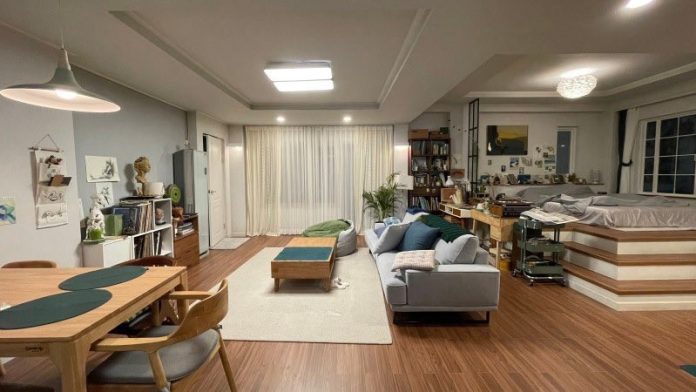
In contrast, the protagonists’ more modest homes tell a different story. Smaller apartments are functional, flexible, and visibly lived in. Furniture is practical, objects accumulate, and the rooms adapt to daily needs. What emerges is proximity: people have to share air, space, and the messiness of real life.
Design becomes a social divider. Marble floors and sculptural seating communicate authority, while worn surfaces and practical furnishings suggest resilience and urgency. The series doesn’t need to explain inequality; it lets the interiors do the work.
Why Little Women Interiors Speak Globally
Little Women’s interiors resonate strongly beyond Korea because of their clarity. They draw from a shared contemporary language of luxury visible across fashion, art, and design worldwide: minimal, architectural, and emotionally cool.
By avoiding decorative excess and embracing structure, the show embodies a global concept of contemporary luxury: refined, understated, and self-assured. This concept is recognizable in Seoul, Milan, New York, and London, not because it’s generic, but because it speaks a shared modern language.