

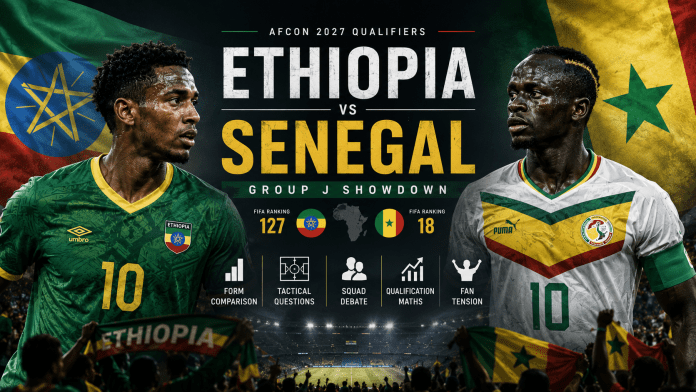
Ethiopia versus Senegal already looks like Group J’s headline fixture. What it does not yet have, based on CAF’s official draw announcement checked on August 28, is a confirmed September date. CAF has placed Senegal, Mozambique, Sudan and Ethiopia together and scheduled Matchdays 1 and 2 between September 21 and October 6, but the published draw notice does not assign Ethiopia-Senegal to a specific day inside that window.
The matchup itself is guaranteed by the home-and-away group format. It also carries a severe competitive gap. FIFA ranked Senegal 18th in July and Ethiopia 143rd.
That difference gives supporters an obvious favorite. It does not eliminate the tactical questions.
Senegal’s 2026 has been stranger than the trophy photographs suggest
Senegal beat Morocco 1-0 after extra time on the field in the AFCON 2025 final on January 18, with Pape Gueye scoring early in extra time. That result no longer stands officially.
On March 17, the CAF Appeal Board ruled that Senegal had forfeited the final after its players had left the field during the late penalty controversy. CAF recorded the result as Morocco 3-0 Senegal. The Senegalese federation subsequently appealed to CAS, which confirmed registration of the case on March 25.
Any current preview therefore needs more precision than simply calling Senegal “the reigning African champion.”
The football itself remains formidable. Senegal entered the 2026 World Cup with players such as Sadio Mané, Kalidou Koulibaly, Edouard Mendy, Ismaïla Sarr, Pape Matar Sarr and Iliman Ndiaye.
The World Cup exposed a more vulnerable Senegal
Senegal’s World Cup ended in the Round of 32. It lost 3-1 to France, 3-2 to Norway, recovered by beating Iraq 5-0 and then surrendered a 2-0 lead in a 3-2 extra-time defeat to Belgium.
Those results change the pre-Ethiopia conversation. Senegal still has elite-level attacking talent, yet its defensive record in North America was far less controlled than during its AFCON run.
Ismaïla Sarr scored twice against Norway and once against Iraq. Pape Gueye struck twice in the 5-0 win. Senegal can attack from several zones rather than depending on one scorer.
For Ethiopia, preventing clean entries into the penalty area will matter more than matching Senegal for possession.
Ethiopia brings four unanswered preliminary-round goals
Ethiopia’s March tie against São Tomé and Príncipe provided a cleaner defensive baseline.
Kenean Markneh scored the opener in the first leg before Abel Yalew added two more. Chernet Gugsaa then produced the only goal in Dire Dawa as Ethiopia completed a 4-0 aggregate victory without conceding.
The level of opposition was much lower than Senegal. Still, Ethiopia has something tangible to carry into Group J: goals from three players and two competitive clean sheets.
The likely plan against Senegal should begin with keeping the contest alive. A 0-0 score after an hour creates pressure on the stronger team. Conceding early could force Ethiopia into precisely the open match Senegal wants.
Squad day will start the real argument
International football gives coaches very little time to repair a bad selection. That makes every omission and injury unusually visible.
Ethiopian supporters will want to know how much of the preliminary-round attack survives into the Group J squad. Senegal’s list will generate a different question: which of its established names are healthy and playing regularly for their clubs when the window opens?
Those updates now travel through several digital channels simultaneously.
The digital matchday begins with federation news and usually spreads into live scores, statistics and community discussion. Official sources should remain the reference point for squads and kick-off details, while fan communities interpret what those facts mean tactically. Inside the same routine, online betting Ethiopia can provide adults with another set of market probabilities to compare against confirmed football information. A Senegal handicap can move after an injury, lineup announcement or venue confirmation. The movement itself does not explain the football reason behind the change. Bookmaker margin also means displayed odds should not be treated as neutral probabilities.
That gives forums something better to debate than a simple predicted score.
Ethiopia’s width will decide how much pressure it can escape
Defending deep for 90 minutes is rarely enough against a technically superior opponent. Ethiopia also needs an exit.
If both full-backs stay low, Senegal can repeatedly recover second balls and restart attacks. If both advance simultaneously, turnovers expose large spaces behind them.
A staggered approach is more plausible: one side advances while the opposite side protects the defensive structure. Yalew or another central attacker then has to hold enough clearances for midfielders to move upfield.
The difference between a counterattack and another Senegal possession may be one successful first touch.
An August prediction should not survive unchanged into match week
The qualification picture is still incomplete. CAF must confirm the exact fixture sequence, venues and kick-off times, while injuries and club form can alter both teams before the window begins. The first Group J result will also affect what each side needs from the next match. When those variables become concrete, a betting market can be interpreted against the new football information rather than an August assumption. A half-goal handicap move caused by a missing defender means something different from movement driven mainly by market volume. Total-goals prices can also shift if Ethiopia’s earlier qualifier reveals a more aggressive or more conservative structure than expected. Fixed bankroll limits prevent every new price from becoming an excuse to increase exposure.
The final lineups should carry more weight than an early headline.
Group J will keep changing the meaning of every point
Senegal is only one part of Ethiopia’s problem. Mozambique and Sudan face the same six-game schedule.
A draw with Senegal could be a major result. Its real value depends on what Ethiopia does against the other two teams. Losing direct matchups while collecting an upset point against the highest-ranked opponent is not a reliable qualification strategy.
The middle window runs November 9-17. The final two matchdays fall between March 22 and 30, 2027.
By then, supporters will be calculating points and goal difference rather than FIFA ranking gaps. Until CAF confirms the first fixture order, the biggest unresolved fact remains the calendar itself.