

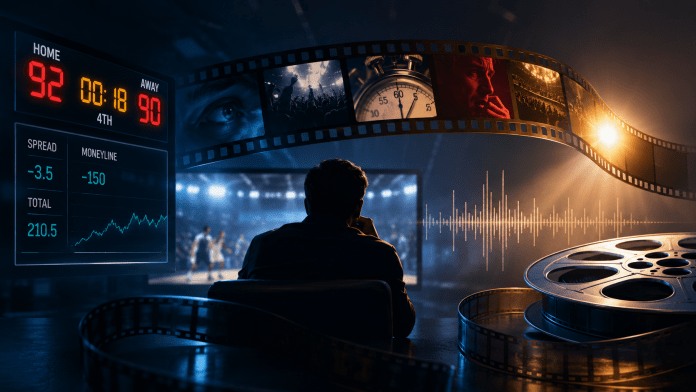
A strong betting scene does not need much exposition. The camera can show a number on a board, a character checking the clock, and a room going quiet, and the audience understands that the story has tightened. The wager gives the scene shape, but the pressure comes from behavior. Who knows the math? Who pretends not to care? Who reacts too early? In good screenwriting, the bet is never only a bet. It is a fast way to reveal nerve, judgment, loyalty, panic, and pride.
Film works this way because viewers build meaning from small pieces while the story is moving. A PLOS One study on how narrative film captures attention found that an intact, engaging film drew viewers so deeply into the story that they were less likely to remember a separate task. That helps explain why a betting scene can feel clear even when the dialogue stays light. The viewer is already tracking faces, sound, score, timing, and consequences at once.
When a Scene Uses Odds as Story
Sports betting scenes become easier to read when the terms are not treated as mystery words. The number on screen is rarely there for decoration. It tells the viewer what kind of pressure the character is under. A spread makes the margin matter. A moneyline keeps the focus on the winner. A total turns every run, goal, basket, or touchdown into part of a bigger scoring rhythm. Futures stretch the tension beyond one night, while live lines make the moment feel unstable because the situation is still moving.
That real-world vocabulary helps explain why a quick scoreboard shot can carry so much weight in a film. For a grounded sports context, take a look at online sports betting at Bovada, which shows how those terms sit around actual games across football, basketball, baseball, hockey, soccer, tennis, golf, live events, and other sports. Its sports page also explains common terms, such as spread, parlay, moneyline, and odds, which is useful for reading a scene without turning the moment into a technical lesson.
If a character flinches after a late basket, the reaction may not be about the winner alone. It may be about the margin, the total, the timing of the score, or the way a single play changes what everyone in the room thought they were watching. Once the viewer understands that, the drama becomes sharper. A cut to the clock, a number on a board, or a silent reaction can say more than another line of dialogue.
That same viewing habit carries into films outside of sports. BovadaHub highlights four movies perfect for Netflix & Chill, pointing to All In: The Poker Movie, Casino Jack, Killing Them Softly, and Rain Man. Each title uses games or high-stakes decisions in a different way. Poker history becomes culture. Political pressure becomes a character study. A protected card game becomes the spark for crime tension. Blackjack becomes part of a road-movie relationship. The useful thread is not the setting itself. It is how quickly a game can reveal who is calm, who is bluffing, and who understands the moment before everyone else does.
4 Details That Make the Scene Work
The first detail is the face before the result. Directors often show the person watching before they show the thing being watched. A scoreboard gives information. A face reading it gives drama. The viewer looks for fear, calculation, relief, or the small overreaction that gives the character away.
The second detail is the room. Background noise often works like a pressure gauge. A bar gets louder, then drops. A table full of chatter narrows into silence. A watch party freezes because everyone senses the next play will change the scene. Sound tells the viewer when to lean forward.
The third detail is what the script leaves out. Good scenes trust the audience to catch enough. If every term is explained, the pressure leaks away. A line like “we need three” can do more than a long explanation because the clock, cut, and reaction carry the meaning.
The fourth detail is the private result inside the public result. A team can win while a character loses face. A hand can end while a relationship cracks. A race can finish and leave one person calm because they saw what others missed. That split is why betting scenes work even for viewers who do not follow the sport or game closely. The official outcome is only half of the scene. The rest is the private reaction.
Why Rewatching Changes the Scene
The first viewing usually belongs to suspense. The second belongs to setup. Once the ending is known, the viewer starts noticing how the scene pointed there from the beginning. The character who talked too much was already nervous. The one who barely moved was not detached. The quick glance across the room carried more weight than the big reaction after the result.
This is where betting scenes become more than genre decoration. They reward attention because they are built from readable signals. A line on a screen, a pause before a call, a friend’s change in tone, or a sudden cut to silence can tell the viewer where the emotional pressure sits. The craft is compact, which is why these scenes stay memorable after the plot details fade.
The best ones also avoid turning the viewer into a student. They do not stop to teach every rule. They give enough context, then let the scene move. Viewers learn by watching people make sense of pressure in real time. That is the quiet craft behind film editing and viewer attention.