

Searching “is SteamRIP safe” usually means one thing: you are thinking about downloading a game, but something feels a little sketchy. Maybe you saw people on Reddit saying it is fine. Maybe your antivirus flagged a file. Maybe you just want to know whether SteamRIP is actually safe or if it can mess up your PC.
SteamRIP is known for offering free pre-installed PC games, but unofficial game downloads always come with risks. Even when a site looks popular, that does not automatically mean every download is clean, legal, or safe. Malware, fake links, copycat sites, password stealers, and copyright issues are all part of the bigger picture.
So, is SteamRIP safe? The honest answer is: it is not risk-free. This guide breaks down what SteamRIP is, the main safety and legal concerns, whether SteamRIP downloads can contain viruses, and what safer alternatives you can use instead.
What Is SteamRIP?
SteamRIP is commonly known as a site that offers free pre-installed PC games. Its own Linktree describes SteamRIP as a site that provides “free pre-installed steam games” and also warns users to check the URL because of copycat sites.
That wording already explains why so many gamers search for it. A pre-installed game sounds easy. No long setup process, no complicated crack instructions, no waiting for a huge launcher to patch everything before you can play. For someone who just wants to try a game without paying full price, SteamRIP can look convenient.
But convenience is not the same as safety.
The moment you download a game from an unofficial source, you step outside the protection of platforms like Steam, Epic Games Store, GOG, or Microsoft Store. Official platforms are not perfect, but they offer clear publisher information, update systems, refund policies, account protections, and some level of quality control. With unofficial game download sites, you are trusting files that have been modified, repacked, reuploaded, or distributed outside the developer’s intended channel.
That is where the SteamRIP safety question really begins.
Is SteamRIP Safe?
The short answer: SteamRIP should not be treated as fully safe.
That does not mean every person who has ever downloaded from SteamRIP immediately got a virus. Online discussions are full of mixed experiences. Some users say they had no problem. Others worry about antivirus warnings, suspicious redirects, fake buttons, or copycat sites. The problem is that personal anecdotes do not prove safety. One clean download does not guarantee the next file, mirror, ad, or installer is safe.
When people ask “is SteamRIP safe,” they are usually asking several different questions at once. Is the site itself safe to visit? Are the download links safe? Are the game files clean? Is it legal? Can it steal accounts? Can it expose a family PC to malware? Those are separate questions, and the answer is not the same for all of them.
The biggest issue is that unofficial game files are executable software. A PC game is not like opening a normal image or reading a PDF. Games often include .exe, .dll, launcher, patch, and installer files. Those files can request system access, connect to the internet, modify folders, install dependencies, and run background processes. If a malicious actor hides malware inside one of those files, the user may not notice until passwords, accounts, or system resources have already been affected.
So even if SteamRIP looks clean or popular, the safer mindset is this: any cracked, repacked, or unofficial PC game download carries risk.
Can SteamRIP Give You a Virus?
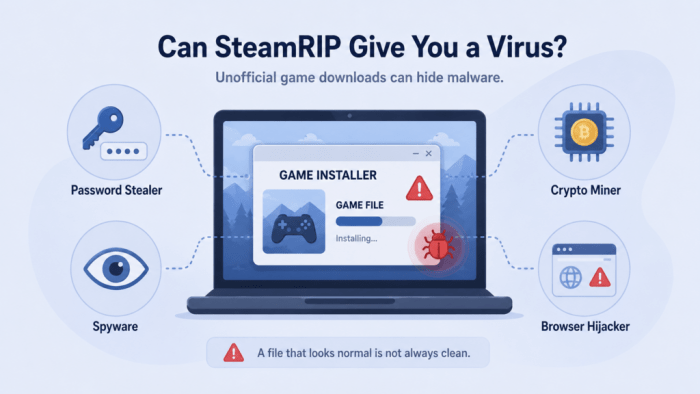
Yes, unofficial game downloads can give you a virus, and this risk is not theoretical.
Security researchers continue to report malware campaigns that use pirated games and modified installers as delivery methods. Malwarebytes reported in June 2026 that attackers were hiding malicious code inside pirated PC game installs and modified launchers. In that case, victims downloaded what looked like normal game files, but the malware attempted to deliver an infostealer capable of grabbing saved browser passwords, cookies, crypto wallets, autofill data, system details, and clipboard contents.
That is exactly why cracked games are attractive to attackers. The user already expects to run an unknown installer. The file is large, so suspicious content can be harder to notice. The user may also be willing to ignore antivirus warnings because they have heard that cracks often trigger “false positives.” This creates the perfect environment for malware to hide.
Some of the most common risks include trojans, spyware, crypto miners, browser hijackers, ransomware, keyloggers, and password-stealing malware. A crypto miner may quietly use your CPU or GPU in the background. A browser hijacker may change your search settings or inject ads. A password stealer is worse: it may target saved browser logins, gaming accounts, email accounts, Discord accounts, or payment-related data.
This is why the question should not be “Has someone on Reddit used SteamRIP without problems?” A better question is: “Can I personally verify that this exact file, from this exact link, at this exact time, is clean?” For the average user, the honest answer is usually no.
Are Antivirus Warnings Always Real?
Not always, but you should never ignore them automatically.
Cracked or modified game files can sometimes trigger antivirus alerts because the original software has been changed. A crack, patch, keygen, or modified launcher may behave in ways that security tools consider suspicious. That is where the “false positive” argument comes from.
But here is the trap: malware can also hide behind that same excuse.
If a site, comment, or download page tells you to disable Windows Defender, turn off antivirus, ignore browser warnings, or run a file as administrator without question, that is a major red flag. A legitimate game should not need you to lower your security just to install it.
The safest approach is simple: if your antivirus flags a game downloaded from an unofficial source, take the warning seriously. Do not assume the file is safe just because other people say it worked for them. Other users may have downloaded a different version, used a different mirror, or simply failed to notice the infection.
SteamRIP Copycat Sites Make the Risk Worse
Copycat sites are one of the biggest reasons SteamRIP safety is hard to judge.
SteamRIP’s own Linktree warns that there are copycats and says users should check the URL. That matters because many users do not arrive through a carefully typed domain. They arrive through search results, Reddit threads, Discord messages, YouTube descriptions, ads, reuploaded links, or random “download” buttons.
A copycat site can look convincing. It may copy the design, use similar wording, display game artwork, and create download pages that feel familiar. But the file behind the button can be completely different. It may be a fake installer, malware loader, browser extension scam, survey trap, or archive that pushes users toward more dangerous mirrors.
Even third-party security pages often give mixed signals. For example, one MalwareTips scan page noted that the domain had some clean technical signals, but still described the site as presenting commercial games for direct download and pointed to elevated risk because of the unauthorized distribution model.
That is the core problem. A site can have SSL, traffic, a familiar interface, and community mentions while still being risky from a file safety and legality perspective.
Is SteamRIP Legal?
SteamRIP legality depends on what is being downloaded and where you live, but the general rule is clear: downloading paid copyrighted games without permission is usually copyright infringement.
The U.S. Copyright Office states that uploading or downloading protected works without the copyright owner’s authority infringes the owner’s exclusive rights of reproduction and distribution. While laws and enforcement vary by country, “free download” does not automatically mean “legal download.”
This is also why “safe” and “legal” should not be mixed together. A file can be malware-free and still unauthorized. A download can be illegal even if it works perfectly. On the other side, a legal site can still have a bad ad or a compromised file, although official stores generally offer far more accountability than piracy sites.
For most users, the practical takeaway is simple: if a game normally costs money on Steam, Epic, GOG, or another official store, and another site offers the full version for free without the publisher’s permission, you should assume there are legal risks.
Is SteamRIP Safe for Kids or Shared Family PCs?
SteamRIP is not a good choice for children or shared family computers.
The risk is not only the game file. Kids may click fake download buttons, accept browser notification pop-ups, install unknown launchers, or follow instructions telling them to disable security tools. They may not understand the difference between an official download button and an ad. They may also reuse the same password across gaming accounts, email, and social platforms, which makes password-stealing malware more damaging.
For a shared household PC, the stakes are higher. One unsafe game download can affect more than one person. Saved browser passwords, family photos, school documents, payment sessions, and work accounts may all be on the same machine. If the device is used by parents, siblings, or remote workers, a “free game” can quickly become a much bigger problem.
A safer rule for family PCs is to only download games from official stores, developer websites, or trusted subscription services. If a child wants a game that is too expensive, wait for a sale, use a wishlist alert, check for demos, or look for free-to-play alternatives.
Why Do People Still Use Sites Like SteamRIP?
It is easy to say, “Just buy the game.” But that does not fully explain why people search for SteamRIP in the first place.
Games can be expensive. Regional pricing is not always fair. Some players are students or younger gamers with limited budgets. Others want to try a game before committing, especially when modern PC games can be buggy at launch or require powerful hardware. Some users live in regions where certain payment methods, platforms, or titles are harder to access.
Those reasons are understandable. But they do not remove the risk.
The better solution is not pretending the temptation does not exist. The better solution is finding safer ways to play games affordably. Luckily, legal options are much better than they used to be. Between free-to-play games, weekly giveaways, demos, subscriptions, bundles, and seasonal sales, budget gaming does not have to mean gambling with random executables.
Safer Legal Alternatives to SteamRIP
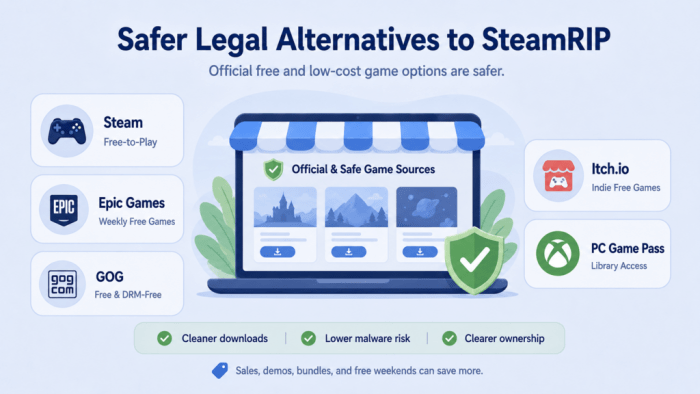
If your main reason for visiting SteamRIP is price, start with official free and low-cost options.
Steam has a dedicated free-to-play section with many PC games across genres. Epic Games Store also offers free games on a regular schedule and says users can claim and keep weekly free games. GOG provides free and DRM-free game options, including classic and indie titles. Itch.io has a large free-games section, especially useful for indie, experimental, horror, visual novel, and short-form games.
For players who want access to many games without buying each one individually, PC Game Pass is another option. Xbox describes PC Game Pass as a subscription that lets users play hundreds of Windows PC games through its library.
These alternatives may not give you every game you want for free, but they are far safer. You get cleaner downloads, clearer ownership rules, account support, updates, and a much lower risk of malware. You also avoid the legal uncertainty that comes with cracked games.
There are also smart budget habits that many gamers overlook. Use Steam sales, wishlist discounts, publisher bundles, free weekends, official demos, and Humble-style bundles. A game that costs $60 at launch may drop heavily during seasonal sales. Waiting is not exciting, but it is much safer than risking your PC for one download.
How to Download Games More Safely Online
The safest rule is boring but true: use official sources first. Steam, Epic Games Store, GOG, Microsoft Store, Itch.io, publisher websites, and verified developer pages are much better choices than random download mirrors.
Be especially careful with any file that asks for administrator access. Some games need elevated permissions for legitimate reasons, but malware also wants those permissions because they make it easier to modify your system. You should also be cautious with password-protected archives, unknown .exe files, suspicious .dll files, scripts, patchers, and anything that tells you to disable antivirus before installation.
A VPN can help protect your network privacy, especially on public Wi-Fi, but it cannot make a malicious file safe. This is an important distinction. A VPN may hide your IP address from some network observers and encrypt traffic between your device and the VPN server, but it does not inspect every game file and magically remove malware. If you download an infected installer, a VPN will not save your PC.
Also protect your gaming accounts. Use strong, unique passwords. Turn on two-factor authentication for Steam, Epic, email, Discord, and any account connected to payments. Avoid saving payment details on a device where you regularly test unknown files. If something feels suspicious after installing a game, change your passwords from a different clean device.
Final Verdict: Is SteamRIP Safe?
SteamRIP may be popular among gamers looking for free PC games, but it should not be treated as fully safe. The main risks are not limited to one site or one download button. The real issue is the entire unofficial game download ecosystem: modified files, fake mirrors, copycat sites, malware, password stealers, antivirus warnings, and copyright problems.
If you only remember one thing, make it this: a game file is software, and software can do damage. Saving money on a game is not worth losing access to your email, Steam account, Discord account, crypto wallet, school files, work documents, or family PC.
For budget gamers, the smarter path is to use legal free games, official demos, subscription libraries, giveaways, and sales. You may not get every game instantly, but you will get something more important: a safer PC, cleaner downloads, and fewer reasons to panic after clicking “Install.”
SteamRIP Safety FAQ
Is SteamRIP safe to use?
SteamRIP is not risk-free. Even if some users claim they have used it safely, unofficial game downloads can expose you to malware, fake links, copycat sites, privacy risks, and legal issues.
Is SteamRIP legal?
Downloading paid copyrighted games without permission is usually copyright infringement. Laws vary by country, but unauthorized downloads are not the same as legal free games.
Can SteamRIP downloads contain viruses?
Yes. Any unofficial game download can contain malware, especially if the file comes from a mirror, copycat site, modified installer, or fake download button.
Why does antivirus flag cracked games?
Sometimes modified files trigger antivirus tools because they behave differently from official software. But that does not mean every warning is a false positive. Malware often uses the same excuse to make users ignore real alerts.
Is SteamRIP safe without a VPN?
A VPN does not make SteamRIP safe. It can help with network privacy, but it cannot verify whether a downloaded game file is clean, legal, or safe to run.
What are safer alternatives to SteamRIP?
Safer alternatives include Steam free-to-play games, Epic Games Store free games, GOG free games, Itch.io free games, PC Game Pass, official demos, free weekends, and seasonal sales.