

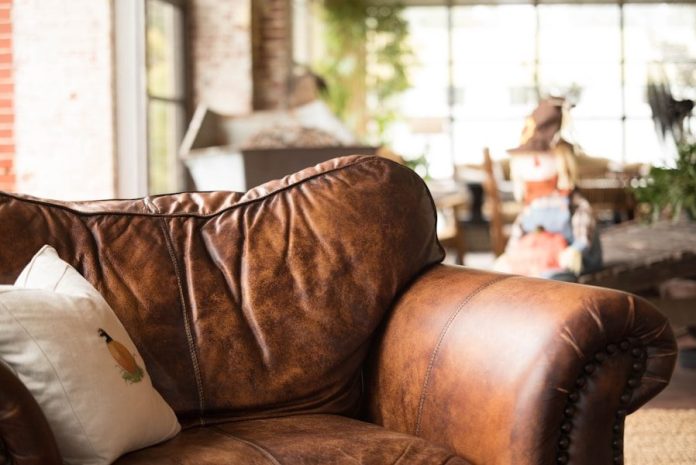
Leatherette vs fabric sofa for Indian summer? This question haunts everyone setting up their new living room. The mercury starts rising from March, and then the monsoon sets in June. Summers are getting hotter, and nobody wants to sweat while watching TV sitting on a sofa.
The difference between a leatherette and fabric couch lies more in chemistry than comfort. These two materials feel almost the same in heat; however, they fail in different ways. Rising temperatures accelerate one failure more than the other. It changes how long you are willing to commit – this is why the comparison comes up whether a household should rent a sofa or buy one.
What does a Sofa have to do with India’s Rising Temperature?
According to the Assessment of Climate Change over the Indian Region, the country sees 7.4 more warm days per decade between 1951 and 2015. The rate is increasing, with more intense warm days.
The warmest day of the year rose by about 0.07°C per decade between 1951 and 2015, but by about 0.21°C per decade between 1986 and 2015.
The data matters because of the upholstery you use during the day. With warm nights becoming more frequent, your sofa does not cool down overnight. The materials degrade faster than usual.
Leatherette vs Fabric Sofa: Two Different Materials Face the Same Challenge
Contrary to many people’s assumptions, leatherette is not a lower-grade leather. It is PU or PVC film bonded onto a textile backing. On the other hand, fabric is woven fibre throughout. There is a structural difference between a fabric sofa and a leatherette sofa, especially because leatherette mimics the role of a plastic skin over cloth.
Heat and Humidity Affect Leatherette
The polymer skin on a leatherette couch wears out due to hydrolysis – water molecules attack the PU’s chemical bonds. That’s why heat accelerates the reaction. Humidity supplies water, and rising temperatures supply energy. With time, the coating thins, cracks, and separates from the backing cloth. Some owners see a sudden peeling one day, but the sofa has been degrading for years.
Heat and Sunlight Age Fabric on the Surface
In heat, fabric upholstery weakens exposed fibres. Direct sunlight, airborne dust, and perspiration can worsen the weave quality.
Fabric is different from leatherette in this context. A woven surface allows water vapour to pass through, whereas a sealed polymer film does not. Leatherette becomes clammy against skin when the room gets warm. Comfort becomes a concern as the summer prolongs.
How Long Do Leatherette and Fabric Sofas Last?
When comparing whether a fabric or leatherette sofa will survive longer, durability might not be the right measure. The hot climate damages the couch, so repairability is another thing to consider.
| Behaviour under heat | Fabric | Leatherette |
| Structure | Woven fibre throughout | PU or PVC film on a textile backing |
| Primary failure mode | Surface wear — fading, soiling, cushion flattening | Hydrolysis — coating thins, cracks, delaminates |
| What rising heat accelerates | Dye fading and fibre weakening | Chemical breakdown of the coating |
| Reversible or terminal | Reversible — cleanable, re-coverable, re-upholsterable | Terminal — delamination cannot be re-bonded |
| Water-vapour transmission | Permeable; moisture passes through | Sealed; moisture stays on the skin |
| Best-fit room | Sunlit, un-airconditioned, humid | Temperature-controlled, spill-heavy |
If you compare reversibly against terminally, fabric fails reversibly. You can repair its surface damage.
However, leatherette sofas fail terminally. When the polymer layer separates from its backing, nothing can reattach it. If you consider patch repairs, it becomes visible – new materials cannot match around the old upholstery.
This means heat pushes a fabric couch towards maintenance bills, whereas a leatherette sofa might require replacement.
Should You Rent or Buy a Sofa if You Live in a Warm Region
When someone buys a sofa, they consider long-term ownership. If you choose a material in today’s climate, you may feel annoyed by the next heatwave. The summer heatwaves have been arriving 3-4 times, with longer duration each time. However, owning and renting allocate risk differently.
Ownership Locks in Material; Renting Allows Upgrades
Buying a sofa is a fixed decision. If leatherette was chosen for a room that later turns out to receive long afternoon sun, the household bears both the degradation and the replacement costs.
A sofa rental separates the two. Because the provider owns the asset, material-level ageing sits with them, and the household can change specification when the room or season proves the first choice wrong. Rental providers allow users to change the couch after a specific period.
The trade-off worth considering is that renting costs more over a long horizon but offers enough time to avert the challenge.
How to Choose the Right Sofa for Your Space: Leatherette vs Fabric Couch
Choosing the right sofa for a space starts with the room’s thermal behaviour.
1. Audit the room’s heat before the showroom.
Window direction, hours of direct sun, and whether the room is air-conditioned matter more than any material’s advertised specification.
2. Match the material to the dominant stress.
Sunlit, un-airconditioned or humid rooms favour fabric. Leatherette earns its place if you have kids and pets and want the room to stay temperature-controlled.
3. Size to the space, not to the price.
Measure clear floor and walkway width first; a modular or L-shaped piece often fits an awkward layout that a fixed three-seater will not.
4. Decide the replacement horizon.
Leatherette suits a shorter cycle. Fabric on a solid frame suits a long one, because it can be re-covered instead of replaced.
Last Minute Takeaway
The fabric vs leatherette sofa decision comes down to which kind of failure a household can absorb, not which material feels cooler through its first summer. Fabric buys recoverability: it fades and soils, and all of that can be undone. Leatherette offers wipe-clean convenience.
Rising temperatures decide how much that recoverability is worth. Before choosing a fabric or leatherette couch, you should match the material to how it accommodates the room temperature. This will show the real picture of whether you should invest in the sofa for the long term or the short term.