

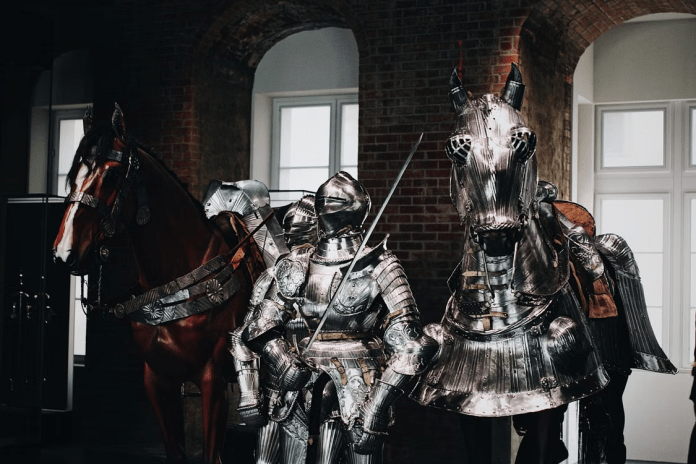
Just ten years ago, the equipment choice for roleplaying games seemed obvious: steel for those who value realism, and leather for those who value freedom of movement. But in recent years, everything has changed, and PU armor has gone from being a rarity to one of the most talked-about gear options.
Players are tired of choosing between beauty and comfort. They’ve found a material that combines both qualities. The reason is simple. Modern festivals last for several days straight, and participants spend ten to twelve hours a day in their costumes.
In such conditions, the weight and comfort of armor become no less important than its appearance. It’s no surprise that workshops worldwide have begun to rethink their traditional approaches to gear production. And LARPSHOPKEEPER offers simply perfect solutions for such situations.
What Is Polyurethane Armor and Why People Say It’s So Good
Polyurethane resin is a relatively brittle material on its own. But when combined with fiberglass reinforcement, it becomes a durable composite. This material can withstand impacts, prolonged wear, and vigorous movement. This resin and fiberglass combination is used in modern PU armor production, including equipment from the LARPSHOPKEEPER workshop.
Unlike foam uniforms, polyurethane retains crisp edges, deep carvings, and fine detail — something typically lost when working with softer materials. Compared to steel, it offers significant weight savings with significantly lower maintenance costs. Importantly, resin does not fade or warp from moisture, so armor retains its marketable appearance even after a rainy festival.
Steel, Leather, or Polyurethane: Each Material Has Its Own Role
Steel remains the historical accuracy benchmark. It is excellent for reenactment and full-contact combat, but it requires maintenance and adds weight that becomes noticeable after only a few hours of use.
Leather is good for its flexibility and atmosphere. However, creating complex decorative elements or symmetrical patterns by hand is no easy task, especially if you need several identical suits.
Polyurethane solves this problem differently. While it doesn’t claim historical accuracy, it allows you to create highly detailed fantasy images that remain practical for real-life use.
Thanks to mold casting, the same equipment can be reproduced as many times as needed — with consistent quality in each copy. This is especially convenient if a character needs to look the same at different events, and the old armor has worn out.
Why Lightweight Armor Is More Than Just Comfort
The weight difference between steel and polyurethane armor may seem insignificant on paper. But in reality, it’s noticeable after just a couple of hours of active play.
Tired shoulders and back affect more than just comfort. Prolonged load carriage has been shown to accelerate muscle fatigue and reduce physical performance, which in a LARP context means slower reactions in combat, less time spent in character, and more time looking for a quiet spot to remove your uniform than interacting with other players.
If you summarize the main advantages of lightweight design in one place, the list would look like this:
- less fatigue over a long day;
- freedom of movement in combat;
- comfort when transitioning between locations;
- no pressure on the shoulders;
- easier to carry throughout the festival;
- easier to transport to the event.
That’s why more and more workshops, including LARPSHOPKEEPER, are prioritizing not only visual appeal when developing new sets, but also how the equipment will feel after eight hours of continuous wear. This approach is gradually changing the very culture of RPG gear production.
How Armor Is Born: From Concept to Finished Product
Developing high-quality PU armor is a long-term effort. It starts with concept art of the characters, which is then turned into a detailed 3D model. At this stage, you decide how the finished equipment should fit, which details can be simplified for greater comfort, and which features need to remain unchanged so the design is still recognizable.
The model is printed with a resin printer to create an exact master copy of the future armor. You don’t pour the whole mould. You go layer by layer, and brush a silicone mould that you take out by hand.
To prevent the final mould from deforming in later casting, it is reinforced with a rigid outer shell. Then the actual casting: a thin layer of resin to preserve the fine detail, then fiberglass reinforcement for strength.
The part is then cleaned of flash, primed, and painted by hand with distressed, metallic, or battle-damaged effects added depending on character design. On the range, in actual battle, a final coat of protection against abrasion and moisture is applied to the uniform.
What’s Important to Check Before Buying Finished Armor
Not all PU armor is created equal. The quality of the final product depends on the meticulous attention paid to each production stage — from the accuracy of the master model to the thickness of the reinforcement layers. Before purchasing, pay attention to several key points:
- fiberglass reinforcement;
- precise seams and fasteners;
- quality of paint and finish;
- fitting adjustment system;
- custom orders available;
- transparency of the production process.
LARPSHOPKEEPER openly demonstrates its production process — from the first sketches to the final packaging of the finished order. This approach allows customers to understand exactly what they’re paying for, rather than buying equipment unthinkingly.
LARPSHOPKEEPER lets customers learn the intricacies of the manufacturing process. This demonstrates the company’s confidence in the quality of its work.
Why Choose LARPSHOPKEEPER
LARPSHOPKEEPER specializes in ultra-detailed polyurethane armor It is available in full sets or individual pieces designed for particular characters. The catalog includes chest plates, shoulder pads, helmets, bracers, and full sets. For those who want something unique, custom orders are available. These orders will be made from scratch based on a custom concept.
Every piece of armor goes through the full production process, including digital sculpting, silicone molding, reinforcement, and hand painting. This approach enables the workshop to create either a unique set or multiple identical pieces for an entire guild or NPC team without sacrificing quality or detail.
The fit care is particularly evident. The straps and fastenings are adjustable to the individual player. This keeps the equipment from sagging or pulling down on the shoulders, even after a long day in the suit.
Buy polyurethane uniform from LARPSHOPKEEPER and get armor that looks great in photos and performs well in actual combat. It’s lightweight, durable, and designed with the premise that your character isn’t just standing around for the camera but is in character the whole festival.
Polyurethane armor is not a replacement for leather or steel. It gives a third option for those who are concerned with comfort, production quality, and detail. Lightweight makes for less fatigue. Fiberglass reinforcement means strength. Molding lets you make copies of your favorite uniform as many times as you like.
LARPSHOPKEEPER assembles this equipment with real-world use in mind. These pieces are perfect for players who want to look like a fantasy hero and still feel comfortable from dawn to dusk on the range.