

You look at your cards and find two queens. A probability chart says a pair appears about 16.94 percent of the time. What does that number tell you now? It tells you how frequently the pair category appears before a fair three-card deal. It does not mean you have a 16.94 percent chance of winning, or an 83.06 percent chance either.
Once the pair is visible, you already know which category occurred. The useful questions have changed: how strong is this pair, what cards remain available and what hands are still active? Treating a category frequency as a forecast of the whole round skips all three questions.
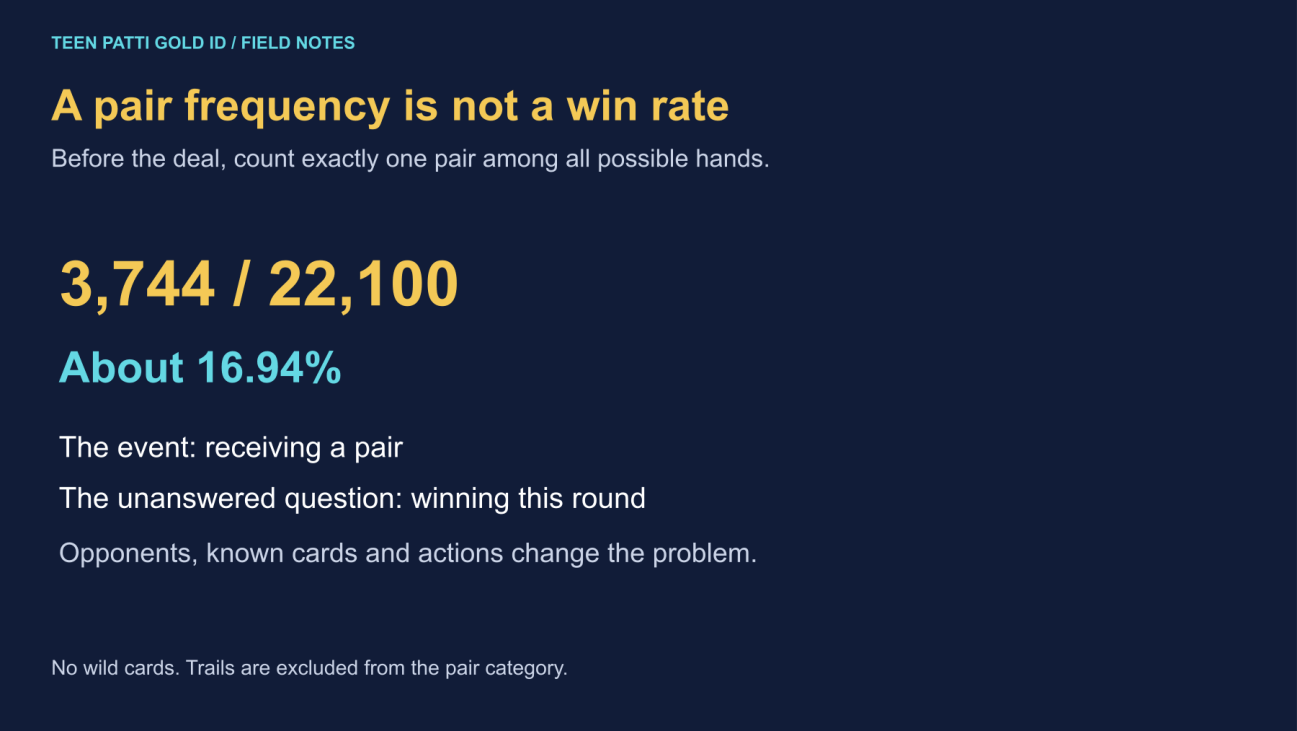
Exactly one pair occurs in 3744 of 22100 hands, about 16.94 percent; this does not specify a round winning chance.
Define exactly one pair
A pair contains two cards of one rank and a third card of a different rank. Three queens make a trail, not a pair. The extra card is often called the kicker because it can settle a comparison between otherwise equal pairs. It cannot normally rescue a lower pair against a higher pair.
For example, two tens with a deuce beat two nines with an ace under ordinary classic comparison rules. The pair rank settles the result first. If both players have tens, compare their unmatched cards. Exact ties need the table’s stated procedure; do not invent a suit preference to force a winner.
Count the pair category from scratch
Choose the repeated rank in thirteen ways. Choose two of its four suits in six ways. The unmatched card can have any of the other twelve ranks and any of four suits, giving 48 choices. Multiplying thirteen, six and 48 produces 3,744 pair hands.
There are 22,100 unordered three-card hands in the full deck. Dividing 3,744 by 22,100 gives approximately 16.94 percent. This original count uses a standard deck with no wild cards and describes exactly one pair. No trail belongs in the numerator, even though three matching cards contain several possible two-card subsets.
The denominator belongs to the question
Before the deal, all 22,100 possible hands are candidates for your cards. After you see Q-clubs, Q-diamonds and 5-spades, your hand is fixed. An opponent cannot receive those physical cards from the same deck. Their possible hands must be drawn from the 49 cards left outside your hand.
That changes the sample space to 18,424 possible three-card combinations for one otherwise unknown opponent. A basic teen patti probability reference is a starting point for recognising this change. The original full-deck percentage cannot simply be copied into a calculation that already conditions on three known cards.
A higher category is only one way to beat a pair
A trail, pure sequence, sequence or color can beat a pair under classic rankings. But a stronger pair can beat it too. Any shortcut that adds only the four higher categories leaves out this important group. The missing hands are especially relevant when your pair rank is low.
Suppose you compare a pair of threes against a pair of kings. Both belong to the same category, but the kings win. Now compare two pairs of threes with different unmatched cards. The kicker matters. To evaluate one particular pair, the calculation must account for both category order and comparisons within the pair category.
More opponents introduce more conditions
Beating one randomly dealt hand is a different event from beating every hand at a full table. Opponents also share the remaining deck, so their possible holdings are not independent. If one person has a particular card, another person cannot have that same card in the same single-deck deal.
There is another complication once play begins. A person still participating may have decided to remain after seeing their cards. Their holding is no longer necessarily represented well by a completely random three-card hand. Without a model of those decisions, a precise-looking percentage can suggest much more knowledge than the calculation actually contains.
Work through comparisons before looking for a shortcut
| Your pair | Comparison hand | Ordinary result |
|---|---|---|
| Two queens with a five | Two jacks with an ace | Queens win by pair rank |
| Two queens with a five | Two queens with a nine | Nine kicker wins |
| Two queens with a five | A mixed-suit 4-5-6 | Sequence wins by category |
These are separate hypothetical comparisons using compatible physical cards. They are not three opponents from one simultaneously specified deal. That detail matters when constructing exercises: using the same queen several times across one alleged table can make an example impossible before any probability is calculated.
Use the number for the job it can do
The pair frequency is useful for setting expectations about how often a category appears in a long series of fresh random hands. It also helps you audit a complete hand-frequency table. It cannot, by itself, decide whether a specific contribution is sensible or predict a round’s outcome.
Practise sorting teen patti hands in two passes. First compare categories, then compare the ranks inside matching categories. Write down which comparison step produced the answer. This builds a more reliable foundation than memorising a percentage and hoping it applies whenever the screen shows two matching ranks.
Ask a narrower question
Instead of asking whether a pair is “good,” ask whether your particular pair beats a specified comparison hand under stated rules. That question has a checkable answer. Next ask how many unknown opponent hands beat it, using only the remaining cards. That is a more demanding but still well-defined calculation.
A whole-round winning chance requires additional assumptions about participants and decisions. If those assumptions are unavailable, stop at the result you can justify. A limited, accurate explanation is more useful than a confident percentage built from the wrong event.
Frequently Asked Questions
How often does exactly one pair appear?
In a fair three-card deal from a standard 52-card deck without wild cards, 3,744 of 22,100 combinations contain exactly one pair, about 16.94 percent.
Does an ace kicker beat a higher pair?
No under ordinary classic comparisons. Compare the repeated rank first. The unmatched card matters only after the pair ranks are equal.
Does the pair percentage include trails?
No. A trail is a separate category. Including it would change the event from “exactly one pair” to a different condition.
Can two players have the same pair rank?
Yes. A deck has four cards of each rank, so two players can each hold two of them. Their kickers may settle the comparison.
Is the complement of 16.94 percent my winning chance?
No. The complement is the probability of receiving something other than exactly one pair before the deal. It says nothing directly about winning the round.