


Many Teen Patti arguments begin before anyone notices a problem. One player assumes A-2-3 is the highest sequence. Another assumes a tied show splits the pot. A third believes a seen player simply matches the last contribution. The first few rounds may pass quietly until a particular hand exposes the disagreement.
The solution is to agree on the small number of rules that change decisions and outcomes before dealing. A brief table agreement is more useful than trying to settle a rule after everyone can see who benefits from each interpretation.
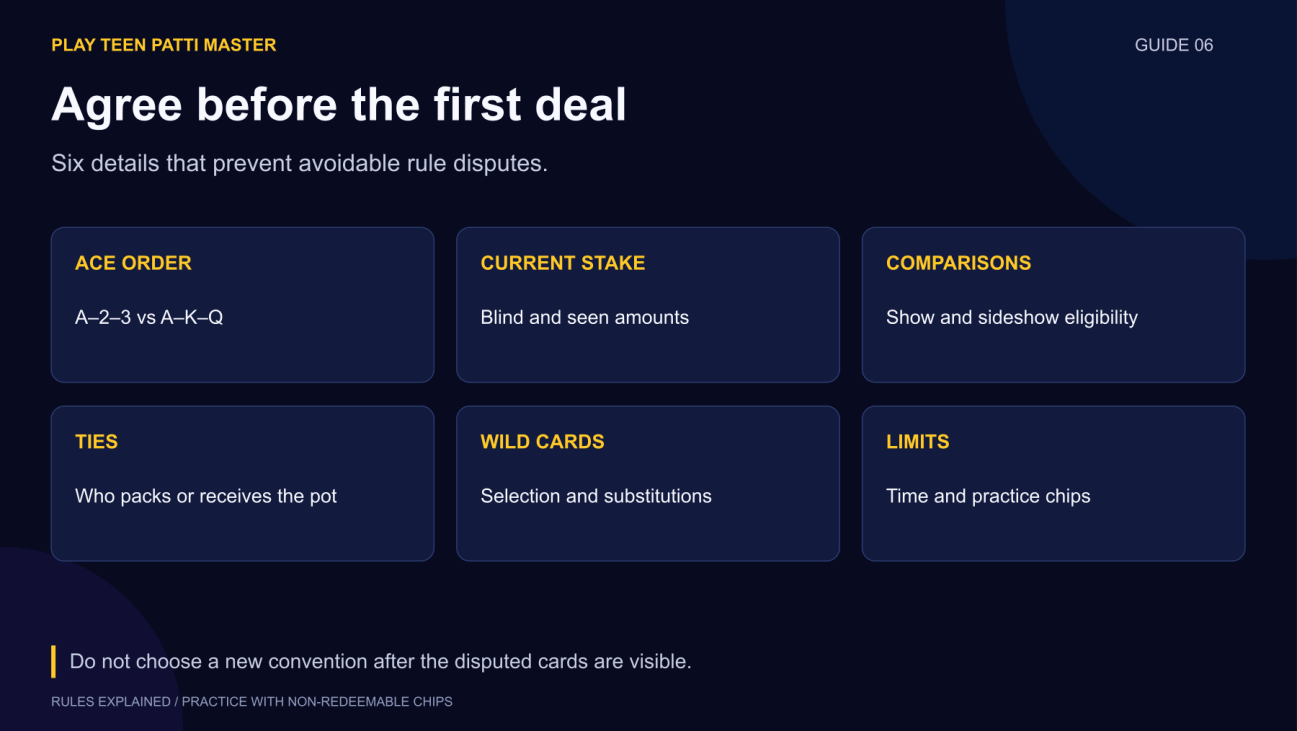
Six pre-game agreements cover ace order, current stake, comparison eligibility, ties, wild cards and limits.
Start with the Game Mode
“Teen Patti” identifies a family of familiar three-card formats, not every detail of the current game. Begin by naming classic play or a specific variation. Then state whether any cards are wild and whether stronger or weaker hands win.
That prevents a basic misunderstanding: a player evaluating a low-hand game with classic rankings, or overlooking a joker that completes an opponent’s combination.
A review of the teen patti rules can provide the foundation, but the table still needs its own clear agreement on variable details. Use a short written note rather than relying on whoever speaks most confidently after a disputed result.
Settle the Ace Question Before It Matters
A-2-3 and A-K-Q are the best-known source of sequence disputes. Accepted conventions differ, so name their order explicitly. Also confirm whether the same order applies to pure sequences and ordinary sequences.
Saying “ace is high” is incomplete. It does not explain whether A-2-3 is a valid run or where it sits. Write the actual sequence order or use a complete ranking card.
The agreement should also address K-A-2. Under ordinary non-wrapping rules it is not a sequence. If all three cards share a suit, the hand may be a color instead. Suit information therefore belongs in any example used to settle the issue.
Define the Current Stake
Players can agree on the opening boot and still disagree about later contributions. The missing concept is often the current stake, which acts as a reference for blind and seen amounts.
For a sample practice table, blind players contribute one or two times the current stake, and seen players contribute two or four times it. A blind contribution becomes the next stake; a seen contribution sets it at half the chips paid.
If a seen player contributes twenty, the next stake is ten under that model. Another seen player’s minimum is twenty, while a blind player’s minimum is ten. Neither should guess from the previous amount without considering status.
Keep a visible marker for the current stake during early practice rounds. It saves repeated explanations and makes arithmetic errors easier to catch immediately.
Show and Sideshow Need Separate Agreements
A show normally concerns the final eligible players. A sideshow is a private comparison during an ongoing round between players who meet the table’s conditions.
Specify when each action becomes available, who may request it and what payment applies. A seen player facing a blind opponent may be unable to demand a show under a traditional convention. Sideshow eligibility can also depend on more than whether two participants have looked at their cards.
Some tables require all remaining players to be seen before a sideshow. Others use different eligibility conditions. A request may be accepted or refused. These details should come from the selected rules, not from assumptions carried over from another app.
Do Not Assume Ties Split the Pot
Two matching rank patterns do not necessarily produce an equal split. Some traditional comparison rules make the requester lose an exact tie, while other implementations handle certain comparisons differently.
Distinguish a show tie from a sideshow tie. The former may determine who receives the pot. The latter may determine which participant packs while the round continues.
Also decide whether suits ever rank independently. Do not invent a spades-beat-hearts rule simply because two hands have matching ranks. If the adopted rules do not use suit superiority, suit symbols alone cannot settle the tie.
| Topic | Agreement to record |
|---|---|
| Format | Classic, low-hand or named wild-card game |
| Ace sequences | Accepted runs and their exact order |
| Contributions | Boot, current-stake calculation and maximums |
| Blind turns | Whether a limit applies |
| Comparisons | Eligibility, payment and refusal rules |
| Ties | Separate show and sideshow outcomes |
| Session limits | Duration and non-redeemable practice-chip allocation |
Wild Cards Need More Than a Name
If the group switches to AK47, identify the ranks treated as wild. For a joker format, explain how the joker is selected and whether the rule covers one physical card or every card of the indicated rank.
Then decide how completed hands are compared. Does a natural combination receive preference? Are all-wild holdings restricted? Must a substitution correspond to a distinct card? If the chosen game has published answers, use those answers consistently.
Groups learning how to play teen patti should settle classic comparisons before introducing these extra questions. One new mechanism at a time is easier to understand than changing ranks, betting and wildcard treatment simultaneously.
What to Do When a Rule Was Omitted
Pause the hand and describe the disagreement without assigning blame. Record the relevant cards, player statuses and action sequence. Then check any written rules already adopted.
If no rule exists, acknowledge the gap. Agree together on a resolution for the current hand and document the convention for future deals. Do not pretend a newly chosen answer was announced earlier.
Frequently Asked Questions
Does a home game need a long rulebook?
No. A concise agreement covering the variable details is enough for a small practice session. The point is clarity, not paperwork.
Can the dealer change the rules mid-round?
The agreed rules should remain fixed for the active hand. Discuss changes before the next deal, when nobody can use visible cards to choose a favourable convention.
Should show and sideshow ties use one rule?
Do not assume so. Record both procedures because one ends a hand while the other removes a participant.
Can suit symbols settle an exact tie?
Only if the adopted rules explicitly rank suits. Do not invent suit priority after seeing the cards.
What is the simplest starting format?
Use classic play with counters that have no cash value. Keep time limits, explain each action and pause for questions. Real-money play requires applicable age and regional eligibility and carries financial risk; agreement on rules does not guarantee winnings.