


Two brokers can display the same underlying market while offering traders a different CFD experience. The reference asset may be identical, such as the S&P 500, gold, EUR USD, or a listed share, yet the contract is offered under each provider’s own conditions. Matching market names therefore do not guarantee matching costs, margin, execution, or platform features.
A CFD is an over-the-counter derivative rather than ownership of the underlying asset. The trader and provider exchange the difference between the opening and closing value of the position. The underlying market supplies the economic reference, while the broker sets important terms around the contract and trading service.
For traders who want to see these differences organized in one place, comparing the best CFD brokers through WR Trading, a dedicated broker review portal, shows how providers can vary in spreads, commissions, leverage, platforms, execution, and instrument range even when they cover many of the same markets. The useful lesson is that several conditions combine to shape the actual trade.
The Price Can Look Similar While the Trading Cost Changes
Spreads and Commissions Are Provider-Specific
The first difference is usually visible in the quote. A CFD provider may build its charge into the bid-ask spread, charge a separate commission, or use a mixture that depends on the account and asset class. Two platforms following the same underlying price can therefore show different dealing costs.
The FCA highlighted this point in its 2025 review of CFD providers. It noted that OTC CFD providers have considerable scope to determine the overall price paid by retail clients, with bid-offer spreads, commissions, and overnight funding among the areas examined.
A fair comparison should record more than the minimum advertised spread:
- the typical spread during normal trading hours;
- any commission charged per side or round turn;
- minimum commissions on share CFDs;
- currency conversion costs where relevant;
- whether pricing changes by account type.
A raw spread account may show a smaller spread while adding commission separately. A standard account may bundle more of the cost into the spread. Which structure fits better depends on position size, frequency, and market choice.
Overnight Financing Can Separate Similar Positions
Holding time creates another difference. Cash CFDs are leveraged products, so positions held beyond a provider’s daily funding cut-off may receive an overnight financing adjustment. The benchmark, markup, formula, and timing can vary by provider and product.
Similar positions can therefore produce different total costs after several nights. Futures-based CFDs can work differently because financing is generally reflected in the futures price rather than charged in the same way as a cash CFD.
For positions likely to stay open overnight, compare:
- the funding formula and benchmark;
- the time at which funding is applied;
- weekend or multi-day adjustments;
- long and short financing rates;
- whether cash and futures-style CFDs are available.
Spreads may matter most to frequent intraday trading, while financing becomes more important over several days. The holding period should therefore be part of the cost comparison from the start.
Contract Terms Affect How the Same Market Is Traded
Margin and Leverage Depend on the Account
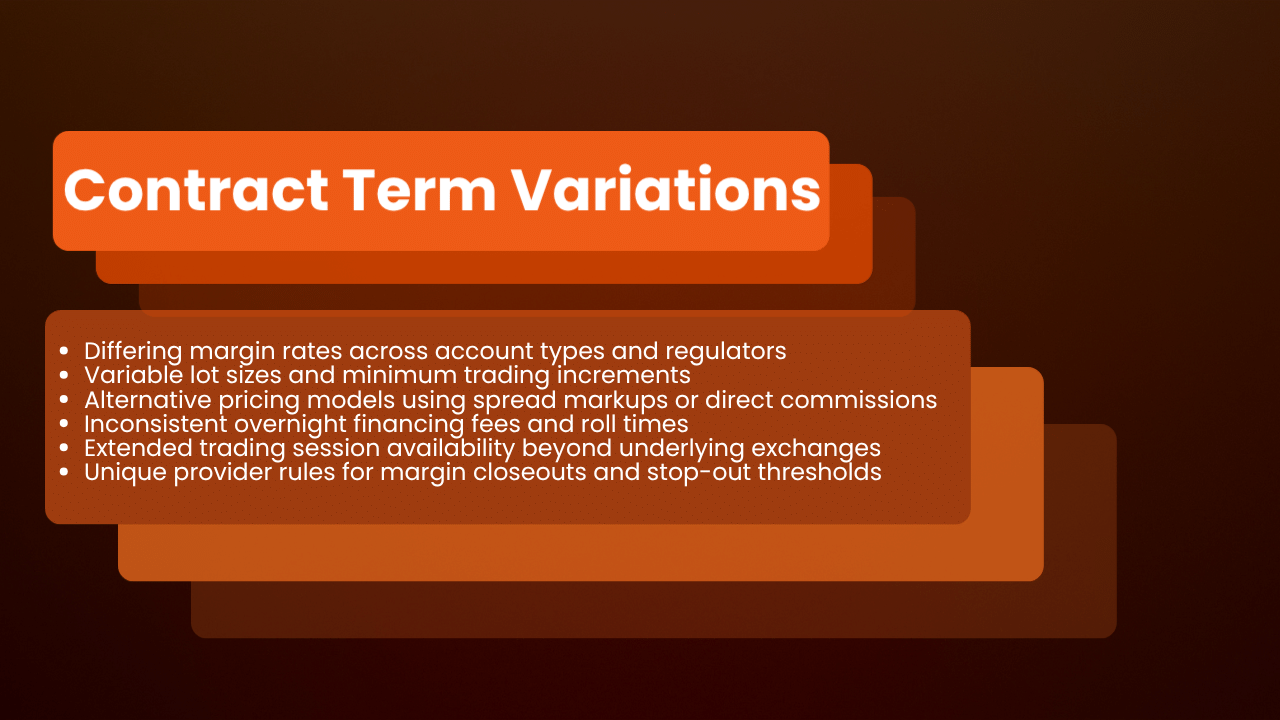
CFDs use margin, so the trader provides only part of the total exposure when opening a position. The required percentage can differ because of regulation, asset class, client classification, provider policy, and position size.
European national CFD measures, for example, apply leverage limits and include margin close-out and negative balance protection for covered retail CFD trading. Other jurisdictions can use different limits, while professional accounts may follow different conditions where permitted.
Leverage should therefore be checked together with the legal entity offering the account.
| Comparison Point | What Can Differ | Practical Effect |
|---|---|---|
| Spread and commission | Markup, raw pricing, commission model | Changes entry and exit cost |
| Overnight financing | Benchmark, markup, funding time | Changes holding cost |
| Margin | Regulation, asset class, account status | Changes capital required |
| Contract size | Value per point, minimum size | Changes position sizing |
| Trading hours | Main and extended sessions | Changes market access |
| Execution | Liquidity, routing, order handling | Can affect fills |
| Platform | Orders, charts, alerts, automation | Changes position management |
Contract Size Changes the Exposure
The same underlying asset can also come with different contract specifications. One provider may define an index CFD with a particular cash value per point, while another may allow smaller increments or use a different minimum size.
Position size determines how much a market move changes profit or loss. Traders should check value per point, minimum order size, increment size, and account currency before assuming that the same number of lots represents the same exposure.
Share CFDs may be sized in shares, while commodity and index CFDs may use contracts. Forex-based CFDs often use lot conventions. The specification behind the market matters more than the label alone.
Trading Hours Can Differ
Some CFD markets follow the main exchange session closely, while others offer extended access using related futures markets or other pricing methods. Spreads can also vary outside the main session as liquidity changes.
A trader comparing the same index at two providers should check both opening hours and spread schedules. These details determine whether the market is available when the trader normally acts and what pricing may apply during that period.
Execution and Platforms Change the Practical Experience
The Same Market Order Can Produce Different Fills
The final fill depends on the provider’s execution process, available liquidity, order size, market movement, and order type. Those factors can make similar orders produce different results.
Market orders prioritize execution rather than one guaranteed price. During quick moves, the executable price may change between submission and fill. Limit orders provide price control, but they may remain unfilled if the required price is unavailable.
For useful comparison, record:
- the spread when the order was submitted;
- the requested and filled price;
- positive or negative slippage;
- execution time where reliable data is available;
- rejected, cancelled, or partially filled orders.
Comparable tests across several sessions provide a clearer view of execution under relevant conditions. This is more informative than treating one unusually fast or favorable fill as representative of every future order.
Platform Tools Shape How the Position Is Managed
Even when pricing and specifications are similar, the software around the CFD can differ. One provider may support MetaTrader, TradingView, cTrader, or proprietary software, while another offers a different combination.
Platforms can vary in charting, watchlists, alerts, order types, one-click dealing, automation, mobile access, and how positions are displayed. Traders who depend on pending orders or automated tools should confirm that the required functions are supported for the relevant account and market.
The broader principle is to turn specifications into comparable evidence. A structured approach to turning raw metrics into actionable insights is useful here because spreads, financing, leverage, execution, and platform features become more meaningful when they are organized around the decision they need to support.
Regulation Can Change the Version of the Product
International broker groups may operate through several regulated companies. The entity serving a client can influence leverage, account protections, complaints procedures, disclosures, and sometimes the instruments available.
In February 2026, ESMA reiterated that existing national CFD intervention measures can include leverage limits, mandatory risk warnings, margin close-out, negative balance protection, and restrictions on monetary and non-monetary benefits. The exact framework still depends on the jurisdiction and entity serving the trader.
Before comparing providers, identify:
- the legal entity holding the account;
- the regulator responsible for that entity;
- the leverage and margin rules that apply;
- whether negative balance protection applies;
- the relevant complaints arrangements.
This keeps the comparison focused on actual account conditions.

Build the Comparison Around the Trade You Plan to Make
Start with one specific scenario: an underlying market, position size, likely holding period, order type, and normal trading session. Then compare what each provider would require for the same intended exposure.
Check contract size and margin first so the exposure is genuinely comparable. Next, add spread and commission, then estimate financing if the trade may remain open overnight. Finally, compare trading hours, execution conditions, and the platform functions needed to manage the position.
This prevents one attractive number from deciding the comparison. A slightly wider spread may come with a contract size or platform that suits the strategy better, while another pricing structure may fit frequent trading more closely.
The market name describes only the reference asset. A CFD also includes pricing, margin, contract, execution, platform, and regulatory terms supplied by the provider, and understanding those layers gives traders a clearer way to compare conditions that fit their own trading approach.