

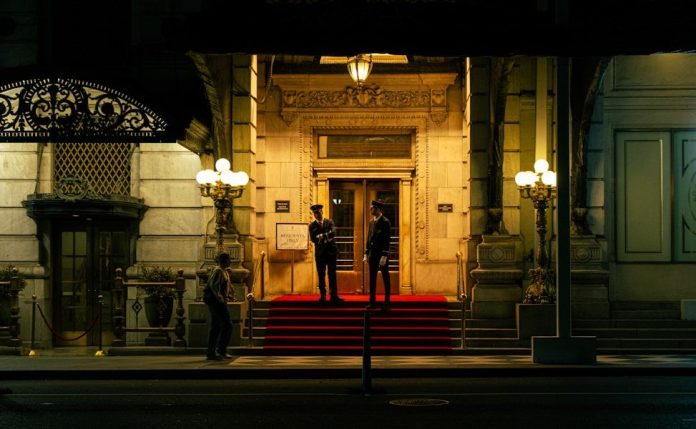
After 11 pm, most buildings that never close run on one person. A 200-bed hotel keeps a night porter behind the desk. A 600-bed hall of residence keeps a duty warden, or a receptionist alone behind a screen with a fire panel repeater on the wall. That single person handles lock-outs, deliveries, ambulance calls, alarm faults and anyone who walks through the front door. On paper, the rota holds. It stops holding the first night two of those things arrive at the same time.
What overnight cover includes
Overnight cover in a building with 24-hour resident access covers five jobs: front door control, fire panel response, welfare calls, incident logging, and first contact with emergency services. Four of those are reactive. Only the first one is not.
Front door control is where the night stands or falls. Residents come back at 2 am and hold the door open behind them. Delivery drivers arrive for a 5 am drop and want the loading bay unlocked. Someone who does not live in the building follows a resident through the lobby, and nobody logs it because the person at the desk was on the phone with an out-of-hours plumber at the time.
Night porter, duty warden, licensed officer
The three roles cover different work and are trained for different outcomes. A night porter is a hospitality job first: luggage, late check-ins, room service, guest recovery. A duty warden in student housing is a pastoral job first: welfare checks, noise complaints, disciplinary write-ups. A licensed officer holds an SIA licence tied to the activity, usually Security Guarding or Door Supervision, and is trained in conflict management, evidence-grade incident reporting and physical intervention thresholds.
Contracted operatives carrying out licensable activity hold a current SIA licence for that activity. That is the baseline, and it is checkable on the SIA’s public register in about thirty seconds. What the licence does not tell you is whether the officer has ever worked a lobby at 4 am with a distressed resident, a fire panel in fault, and a taxi driver arguing about a fare on the pavement outside.
Where the gap opens
The gap opens the moment the person on the desk has to leave the desk. Every overnight incident that requires a physical response, an evacuation, a first-aid call, a room entry, pulls the only staff member away from the entrance, and for the next twelve to twenty minutes the front door is uncontrolled. Properties that buy in hotel security services alongside front-of-house cover are usually solving that exact problem, because two people on nights means the door stays watched while the incident gets dealt with.
Look at your own night incident log for the last quarter. Count how many entries describe someone leaving reception. That number is your real exposure, and it is almost never zero.
Martyn’s Law puts a date on it
The Terrorism (Protection of Premises) Act 2025, known as Martyn’s Law, received Royal Assent on 3 April 2025 and brings in a tiered duty for qualifying premises. Premises expecting 200 to 799 people fall in the standard tier. Premises expecting 800 or more fall in the enhanced tier. Hotels sit inside the Schedule 1 uses of the Act. Private premises, including the residential parts of a building, sit outside it.
The standard tier does not require you to install anything. It requires procedures: evacuation, invacuation, lockdown, communication, and training so staff can carry them out. Enhanced tier adds documented measures submitted to the SIA, which regulates the regime. The Home Office published statutory guidance in May 2026, and enforcement is widely expected around April 2027. Hence, the buildings getting this right now are the ones treating the implementation period as time to rehearse rather than time to wait. Firms such as Alpha Security Services have spent the last year writing lockdown procedure into standing orders for exactly this reason.
Penalties give the timeline teeth. Standard tier carries a £10,000 fixed penalty plus £500 a day. Enhanced tier runs to £18 million or 5% of worldwide turnover.
Move-in weekend breaks every rota
Two dates a year break student housing rotas: move-in weekend and the first weekend of term. A 600-bed scheme can process several hundred arrivals in 48 hours, with parents, hire vans, lift bookings, parcel volume, and a front door propped open for most of daylight. The rest of the year runs on one duty person and a fob reader. That weekend does not.
Operators buying student accommodation security for arrivals weekend and then dropping back to lone cover in week three have covered the visible risk and left the quiet one. The quiet one is a 3 am fire activation in February, when 600 residents assemble outside in the cold, and the building sits open behind them for as long as it takes the fire service to reset the panel. Schemes signed up to the ANUK/Unipol National Code already document evacuation arrangements. Documenting them and staffing them are different exercises.
Five questions before you sign
- Ask how many officers are on site between midnight and 6 am, not how many hours are billed.
- Check the licence type against the activity, not just that a licence exists.
- Read a real incident report the provider has written, redacted, from another site.
- Confirm who holds the fire panel silence code overnight and who is trained to use it.
- Test the escalation number at 3 am, before you need it.
That last one takes two minutes and tells you more than the tender document did. Buildings that never close still get quiet, and quiet is when the cover you bought either exists or does not.