

Anyone who has spent time around fan subtitles has probably seen a folder that looks something like this:
Episode08.srt
Episode08_final.srt
Episode08_final2.srt
Episode08_fixed.srt
Episode08_REALFINAL.srt
It is funny until somebody downloads the wrong one.
The problem is rarely that nobody cared about quality. More often, several people were doing useful work at the same time—translation, timing, editing, checking names, fixing signs—and nobody established a reliable way to say which file had actually reached release status.
For Asian drama communities, that problem becomes more complicated because a single episode may exist in more than one legitimate video edition, while subtitles may also be maintained for different languages and regional audiences. A translation can be excellent and still be unusable if it was timed against a different cut of the episode.
A subtitle file, in other words, is not automatically a finished release.
The Video Version Matters More Than the Filename Suggests
Two files labelled “Episode 8” do not necessarily contain exactly the same video.
A broadcaster version may include a longer opening sequence. An international streaming edition may remove a recap. One release may insert or remove material around commercial breaks. Even when the dialogue is identical, a small difference near the beginning can put every later subtitle out of sync.
This is why a compatibility check should not stop after the first scene.
A basic verification pass should compare at least the opening, the middle of the episode, and a point near the end. If the subtitle is correct at minute two but several seconds late at minute fifty, the problem is probably not an isolated mistimed line.
The release notes should also identify the video baseline wherever possible: edition, approximate runtime, and any relevant retiming information.
“Works with Episode 8” is vague.
“Timed for the 63:42 streaming edition” is useful.
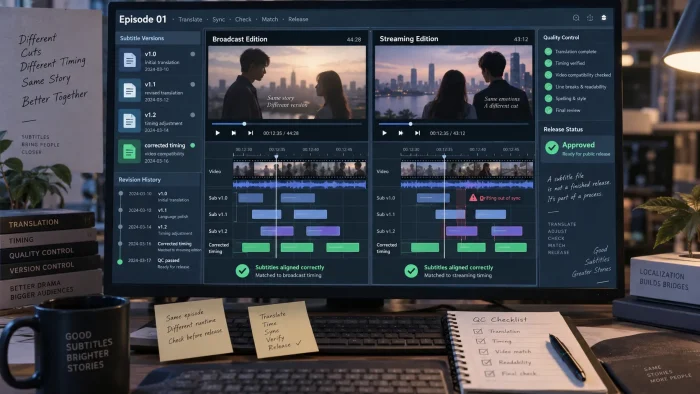
Figure 1. Subtitle version control works best when timing, video compatibility, revision history and release status are treated as separate checks.
Stop Using “Final” as a Version Number
The first “final” file usually means “the version we expected to be finished.”
Then somebody notices a misspelled character name.
The second final version fixes it. A timer adjusts three lines. Somebody else restores a missing sign translation. Within a day, the project has several files with names that only make sense to the people who were online when they were created.
A modest numbering system works better.
Drama_E08_zh-Hant_v1.0.srt
can become:
Drama_E08_zh-Hant_v1.1.srt
without anybody having to decide whether “final-fixed-new” comes before or after “final2.”
The numbering does not need to imitate enterprise software development. It simply needs to preserve sequence.
Chat Solves Questions. It Does Not Solve Release Control.
Subtitle work is conversational by nature.
A translator may need to ask whether a line is sarcastic. A timer may notice that the spoken dialogue starts before the cut. An editor may want to standardize a title that appeared differently three episodes earlier.
Chat is excellent for those exchanges because the feedback loop is fast.
It becomes less reliable when the same conversation is also expected to function as the permanent release archive.
An approved subtitle can disappear beneath hundreds of later messages. A correction can be acknowledged with a reaction but never make it into the public file. Someone joining the project halfway through may find an older attachment before discovering the replacement.
That does not make messaging a bad collaboration tool. It means the team needs to decide what chat is responsible for.
For Traditional Chinese-speaking teams that already coordinate work in Telegram, a resource such as the 紙飛機團隊協作指南 can provide a practical reference for the desktop collaboration layer. The more important editorial rule is broader: discussion can happen in chat, but release status should live somewhere that does not depend on scrolling through chat history.
A Release Needs Enough Metadata to Survive Without Its Author
A subtitle should still make sense months later, when the person who uploaded it is no longer available to explain it.
That requires surprisingly little information.
| Field | Example |
| Episode | Episode 08 |
| Subtitle version | 1.2 |
| Language | Traditional Chinese |
| Video baseline | Streaming edition |
| Runtime | 63:42 |
| Last revised | 17 September 2026 |
| Change summary | Corrected timing and standardized two names |
| Status | Approved release |
This can live in a project page, release post, shared document, repository, or accompanying text file.
The format matters less than the ability to answer a few basic questions without reconstructing the entire project history.
Which video was this made for?
Which revision is it?
Has it been checked?
Has a newer one replaced it?
“Translation Complete” Is Not the Same as “Ready to Release”
A subtitle project moves through different kinds of work, even when a small team does not formally name them.
The translation may be complete while the English still reads too literally. Editing may be finished while the timing is rough. The timing may be clean while recurring names remain inconsistent.
Treating these as separate states makes handoffs clearer.
A practical sequence might move from translation to editing, then timing, quality control, revision, and finally approved release. Teams can combine stages when necessary, but the distinction still helps.
The useful question is not “Is Episode 8 done?”
“What has been completed, and what still prevents this file from becoming the public version?”
That question produces much better answers.
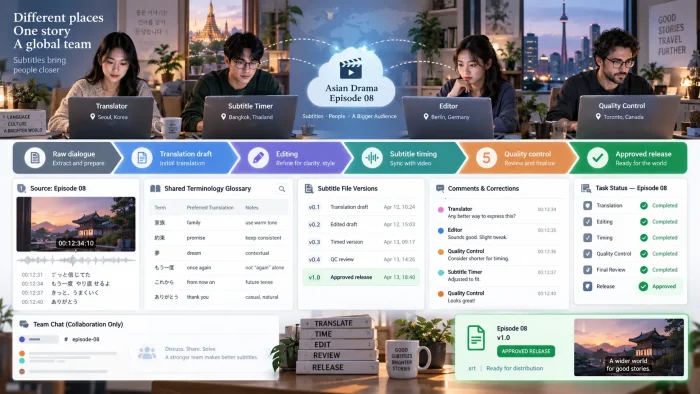
Figure 2. Chat is useful for discussion, but an approved release benefits from a visible workflow, shared terminology and a separate source of truth.
Long Series Turn Small Terminology Choices Into Visible Errors
Terminology drift is easy to overlook in a film. In a 30- or 50-episode series, viewers notice.
Historical dramas are an obvious example. Titles, clans, offices, military ranks, locations, family relationships, and honorifics may recur for months.
Modern dramas have the same problem in less obvious forms. A fictional company name, legal term, school department, app name, nickname, or corporate title can change from episode to episode if translators make decisions independently.
A shared glossary is one of the least glamorous parts of a subtitle project and one of the most useful.
It can be nothing more than a spreadsheet with the source term, approved rendering, context, and a note explaining difficult cases.
Its real purpose is project memory.
A contributor joining at Episode 19 should not have to reverse-engineer decisions made in Episode 3.
Traditional Chinese Requires Editorial Decisions, Not Just Character Conversion
Traditional Chinese localization is often discussed as though the task ends after converting simplified characters.
For drama subtitles, that is not enough.
Hong Kong and Taiwan audiences may differ in preferred terminology, romanization, names, punctuation habits, technology vocabulary, and everyday phrasing. A mechanically converted sentence can be technically readable while still sounding unlike the language normally used by its intended audience.
The target locale should therefore be decided early, not after an entire season has already been translated.
This same distinction appears in software localization. A Telegram 繁體中文版 reference, for example, illustrates how a Traditional Chinese user experience involves interface wording and regional language choices rather than script conversion alone. Subtitle teams face the same editorial question whenever they decide how names, honorifics, occupations, locations, or modern technical terms should appear to Hong Kong or Taiwan viewers.
Consistency matters more when several people share the workload.
Revision Notes Are Part of the Release
A new subtitle version should explain why it exists.
“v1.2 uploaded” is better than nothing, but it still leaves viewers guessing whether the update fixes a cosmetic typo or a synchronization problem affecting half the episode.
A useful revision note can be one sentence:
v1.2 corrects timing after 18:22, standardizes two character names, and restores one missing sign translation.
That tells viewers whether they need the update.
It also gives the team a record of recurring problems. If release after release requires retiming, the timing process deserves attention. If names repeatedly change during QC, the glossary is not being used consistently enough.
Revision history is not only for viewers. It is diagnostic information for the project itself.
Keep Working Files Away From the Public Release Path
Internal production is allowed to be messy.
There may be rough translations, alternative wording, screenshots, timing experiments, spoiler-heavy notes, incomplete subtitle tracks, and files that only exist long enough for another contributor to review them.
The public release area should not look the same.
Only approved files should appear in the main release path. Superseded versions should be clearly identified or moved away from the place where new viewers are most likely to find them.
This reduces a common support burden: answering questions from people who did nothing wrong except download the first plausible-looking attachment they saw.
Spoilers Need Workflow Rules Too
Subtitle teams routinely see material ahead of part of the audience.
That creates an information-handling problem alongside the translation problem.
A screenshot used to discuss line placement may reveal the episode’s ending. A filename can contain a plot detail. A translator discussing a scene in a public channel may unintentionally spoil viewers who have not caught up.
Simple separation helps.
Working discussions should stay tied to the relevant episode. Public release notices should avoid unnecessary plot details. Screenshots used for internal QC should be treated as production material rather than casual promotional images.
None of this needs a complex policy. It simply needs to be intentional.
AI Makes Version Discipline More Important, Not Less
AI-assisted translation can reduce the time required to create a first pass. That does not make release management less necessary.
Automated output can vary terminology between scenes, choose different names for the same person, flatten honorifics, produce literal phrasing, or infer context that was never present in the source dialogue.
Those problems are especially difficult to notice when the output is grammatically smooth.
Teams using AI should therefore be more explicit about what has and has not been reviewed. An AI-generated draft, an editor-reviewed draft, and an approved release are three different things even when they contain mostly the same lines.
Speed at the beginning of the process makes quality gates at the end more valuable.
Compatibility Should Be Tested, Not Assumed
The strongest release notes are based on observation rather than memory.
Before publication, the team can run a short compatibility check against the exact video edition named in the release record.
Check an early scene.
Check somewhere around the midpoint.
Check the final section.
Verify at least one caption containing a recurring character or location name.
Confirm the subtitle encoding and language label.
If a second legitimate video edition is available, testing the same subtitle against both can reveal whether the project needs a separate retimed release.
The result does not have to become a laboratory report. The point is to replace “this should work” with “this was checked against this version.”
That small change significantly improves the credibility of a technical subtitle release.
A Finished Subtitle Should Be Reproducible
A viewer should not need access to the original team chat to understand a release.
They should be able to identify the episode, language, video baseline, revision, and current status from the release itself.
Another contributor should be able to understand why a terminology choice was made.
An editor should be able to see what changed between revisions.
A timer should be able to determine whether a synchronization problem belongs to the subtitle or to a different video cut.
Those are modest requirements, but together they change subtitle production from a chain of one-off files into a maintainable publishing process.
Fan translation has always depended on collaboration. Better tooling can make that collaboration faster, but tools do not decide which file is authoritative, which terminology should remain consistent, or when a draft has actually earned the label “release.”
That remains an editorial responsibility. A subtitle is finished when the team can identify it, reproduce it, correct it, and confidently tell the viewer which version to use.