

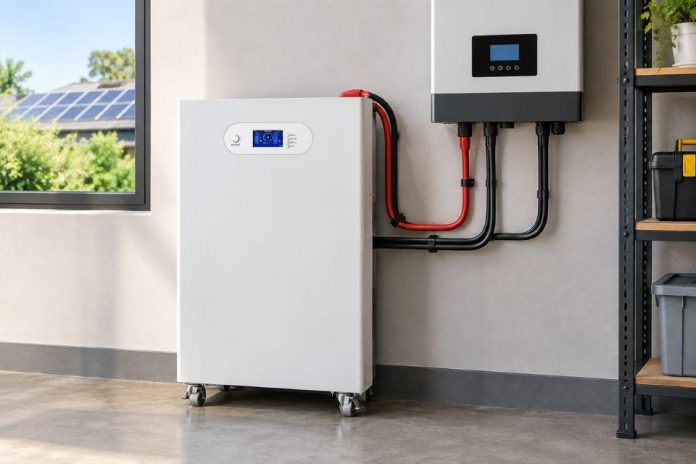
A 15kWh battery rating may look like a straightforward starting point for a solar project, but capacity alone does not determine whether the system is properly sized. Installers need to understand how much energy the site uses, how much of the battery capacity is actually usable, how much power the inverter must deliver, and how the system will operate under local conditions.
For projects across Southeast Asia, factors such as backup expectations, peak demand, temperature, installation space, expansion plans, logistics, and supplier support can also influence the final specification. This makes a 15kWh system a sizing case study rather than a universal solution. The objective is to connect capacity with real project requirements while considering procurement, warranty, and delivered value.
What Does a 15kWh Battery Actually Mean?
A 15kWh battery has a nominal energy capacity of 15 kilowatt-hours. That figure describes the amount of energy stored under specified conditions, but it does not necessarily mean an installation can use the entire 15kWh. Battery manufacturers normally specify an allowable depth of discharge (DoD), while the complete storage system also experiences conversion and operating losses.
For example, if a system allows 80% of its nominal capacity to be used, 15kWh × 0.80 gives 12kWh of usable energy before other losses. The actual figure should come from the battery and inverter specifications. Installers should therefore distinguish nominal capacity from usable capacity when comparing systems. This simple distinction prevents a common sizing mistake: treating the number printed on a product specification as the exact amount of energy available to the loads.
Start With the Load, Not the Battery Size
Professional sizing should begin with the project’s load profile rather than with a preferred battery capacity. The installer first needs to understand how much electricity the site consumes during a typical day, when that consumption occurs, which loads are essential, and how much backup time the customer expects. A building that uses most of its energy during daylight hours can have very different storage requirements from one with heavy evening consumption.
A useful assessment separates daytime and nighttime demand and identifies high-power equipment that may create short periods of peak demand. Refrigeration, pumps, air-conditioning systems, and motors can affect battery and inverter selection even when total daily consumption is modest. The intended operating strategy also matters. A battery used mainly for solar self-consumption may be sized differently from one intended to provide backup during grid outages. The goal is to establish the energy and power requirements before selecting a nominal battery capacity.
How Installers Calculate Usable Battery Capacity
Once the load profile is understood, installers can estimate the nominal storage capacity required to provide the desired usable energy. A practical conceptual formula is:
Required nominal capacity = Required usable energy ÷ allowable DoD ÷ system efficiency
For example, suppose a project requires approximately 10kWh of usable energy, the battery is designed around an 80% usable DoD, and the overall battery-to-load efficiency assumption is 90%. The calculation becomes 10 ÷ 0.80 ÷ 0.90, which is approximately 13.9kWh. A 15kWh nominal system could therefore be a candidate for further evaluation.
This calculation is a starting point rather than a final engineering design. Efficiency, DoD limits, temperature, inverter losses, reserve settings, and manufacturer conditions can change the result. Installers should use the published specifications of the proposed battery and inverter when completing the final design.
Match Battery Capacity With Inverter Power
Battery energy capacity and power capability are related, but they are not the same measurement. Kilowatt-hours describe how much energy the battery can store, while kilowatts describe how much power the system can deliver at a particular moment. A 15kWh battery can therefore have sufficient stored energy for a project while still being unsuitable if its continuous discharge rating or connected inverter cannot support the site’s demand.
Installers should compare the battery’s continuous discharge capability with the inverter’s output rating and examine peak or surge requirements. Equipment such as pumps, compressors, air conditioners, and motors can draw significantly more power during startup. The key question is whether the complete battery-inverter combination can safely provide the required power when loads need it. Consequently, proper sizing must consider both energy capacity and instantaneous power demand.
Why LiFePO4 Chemistry Matters
LiFePO4, or lithium iron phosphate, is widely used in stationary energy-storage applications because of its combination of cycle-life characteristics, thermal behavior, safety characteristics, and suitability for repeated charging and discharging. For solar projects where a battery may cycle regularly, these characteristics can be important when evaluating long-term system performance.
However, chemistry should not be considered in isolation. Cell quality, battery management, thermal management, operating temperature, charging limits, discharge limits, and system design all influence practical performance. Installers should therefore compare the complete battery specification rather than assuming that the chemistry name alone guarantees a particular result. A properly integrated LiFePO4 system can be suitable for many residential, commercial, and project-scale storage applications, but the appropriate configuration still depends on the project’s load profile, inverter requirements, operating environment, and expected cycling pattern.
Cabinet Format, Parallel Expansion and Installation
After determining the required capacity and power, installers need to consider how the battery will physically and electrically fit into the project. Cabinet format affects footprint, service access, enclosure protection, thermal management, and whether the proposed location is appropriate for the equipment.
Expansion capability should also be checked before procurement. A project may begin with a 15kWh system but later require additional storage, making parallel operation, communication protocols, inverter compatibility, and maximum supported capacity relevant. Installation conditions matter as well. Temperature, humidity, cable sizing, grounding, isolation, clearances, and applicable electrical requirements should be reviewed against the manufacturer’s documentation and local rules. A battery’s nominal capacity is therefore only one component of a complete storage-system specification.
What Actually Determines the Cost of a 15kWh Battery System?
The quoted price of a 15kWh battery can be misleading if different suppliers are offering different levels of usable capacity, equipment, warranty coverage, or project support. A professional comparison should consider the battery cells, BMS, enclosure, monitoring, certifications, inverter compatibility, warranty, customization, installation requirements, shipping, duties, and technical support. A lower initial quote may not represent a lower project cost if important components or services are excluded.
When comparing 15kwh battery price Philippines options, buyers should normalize usable capacity, warranty terms, inverter compatibility, included components, logistics, and delivered project cost rather than comparing the battery sticker price alone. This approach is particularly useful for installers and distributors evaluating multiple suppliers for repeat projects. It also helps project developers distinguish between a simple battery purchase and a complete storage solution. The most meaningful comparison is the value delivered over the expected operating period, not simply the lowest number on an initial quotation.
Manufacturer Selection Matters as Much as Battery Size
Choosing a manufacturer involves more than confirming that a battery has the required capacity. Professional buyers may need to evaluate manufacturing capability, engineering resources, quality-control procedures, cell sourcing, testing, certifications, technical documentation, OEM/ODM flexibility, customization, and after-sales support.
When comparing solar battery companies, project buyers should examine evidence that supports the supplier’s stated capabilities. For example, Avepower describes a 20,000 m² manufacturing base, a 50+ member R&D engineering team, LiFePO4 energy-storage solutions, and OEM/ODM customization capabilities. These details provide context, but do not establish suitability for every 15kWh project. Installers should still verify product specifications, certifications, inverter compatibility, warranty conditions, quality requirements, and technical support against the needs of the specific project.
Shipping, Warranty and Total Project Risk
Battery procurement does not end when a supplier provides a product quotation. For Southeast Asian projects, delivered cost can include packaging, freight, insurance, customs, duties, local transportation, documentation, and installation. Requirements vary by market, so project buyers should calculate total delivered cost rather than relying on the factory price alone.
Buyers should check the warranty period, operating conditions, cycle or throughput provisions, DoD assumptions, exclusions, replacement procedures, and responsibilities if a system develops a problem. Technical support can matter when installers deploy multiple systems or integrate batteries with different inverter platforms. Evaluating these factors early can reduce procurement uncertainty and make supplier comparisons more meaningful.
Practical 15kWh Sizing Example
Consider a small commercial solar project that needs approximately 10kWh of usable battery energy for its intended operating period. If the proposed battery allows an 80% usable DoD and the planning assumption for overall system efficiency is 90%, the nominal capacity calculation is approximately 10 ÷ 0.80 ÷ 0.90, or 13.9kWh. A 15kWh battery could therefore be considered as a potential fit.
The installer should next check the site’s peak load, inverter output, battery discharge capability, solar generation profile, required backup duration, operating temperature, and possible future expansion. For high instantaneous demand, power ratings may matter more than energy capacity. The example demonstrates the principle: use 15kWh as a starting point, then verify the complete system.
How Installers Should Evaluate a 15kWh System
A practical evaluation sequence is straightforward:
- Determine the site’s daily and peak load profile.
- Calculate required usable energy.
- Account for DoD and system efficiency.
- Match battery discharge power with inverter requirements.
- Check chemistry, BMS, installation conditions, and expansion options.
- Compare certifications, warranty terms, supplier capability, and total delivered cost.
This framework helps installers avoid choosing a battery simply because its nominal capacity appears to match the project’s daily consumption. It also creates a consistent basis for comparing different manufacturers and system configurations.
Conclusion
A 15kWh battery should be treated as a starting capacity, not a complete system specification. Proper sizing requires installers to consider daily load, usable energy, DoD, efficiency, inverter power, battery chemistry, installation conditions, expansion plans, warranty, supplier capability, and total delivered cost. For Southeast Asian projects, logistics and local operating requirements add another layer to the evaluation.
This approach also makes technical comparisons clearer because every supplier is assessed against the same project requirements. It helps buyers separate capacity claims from actual system performance and long-term procurement value. That distinction is especially important when comparing systems intended for repeated daily cycling.
Installers, EPC partners, distributors, and project developers can also review manufacturers such as Avepower when comparing LiFePO4 and OEM/ODM storage options, while judging every supplier against the technical and commercial requirements of the specific project.
FAQs
1. How do you size a 15kWh battery for a solar system?
Start with the site’s daily energy use, peak demand, backup requirements, usable battery capacity, DoD, and system efficiency. Then match the battery with the appropriate inverter and operating conditions.
2. How much usable energy does a 15kWh battery provide?
A 15kWh battery does not necessarily provide the full 15kWh. At 80% DoD, it offers around 12kWh of usable energy before accounting for additional system losses.
3. Is a 15kWh battery enough to power a house?
It depends on the home’s daily consumption, backup requirements, and connected appliances. High-power equipment may require additional battery capacity or a higher-power inverter.
4. What inverter size is suitable for a 15kWh battery?
The inverter should be selected according to the battery’s continuous discharge rating and the site’s peak and surge power requirements. Battery and inverter compatibility should also be verified.
5. What factors affect the cost of a 15kWh battery system?
Cost depends on usable capacity, battery chemistry, BMS, inverter compatibility, warranty, certifications, shipping, installation, customization, and technical support.