

AI Music Generator platforms are often framed around convenience, but convenience is not the most interesting part of lyric-first creation. The more important question is whether a system can respect the role lyrics play before a song is fully formed. Many song ideas do not begin with polished melody, advanced arrangement, or perfect vocal direction. They begin with a line that feels emotionally charged, a verse that carries narrative weight, or a chorus phrase that suggests a world but not yet a full structure. The problem is that words alone can remain suspended for too long. They need a musical environment quickly enough to test whether they truly belong together.
In my observation, lyric-first creators often face a specific kind of frustration. They are not blocked by imagination. They are blocked by translation. They can write, but they cannot easily hear. They know the emotional posture of a song, but not its final sonic shape. They may want tenderness without weakness, energy without cliché, melancholy without heaviness, or intimacy without emptiness. Those are sophisticated creative goals, yet they are often difficult to convert into a first song draft with traditional production tools. ToMusic AI becomes compelling because it turns lyrics into the center of the workflow rather than something that must wait until composition is mostly decided.
That is why I think the platform makes a strong case as a best music generator option for people who start with language and emotion first.
Why Lyrics Deserve A Different Creative Workflow
A lyric is not just content to be placed on top of music later. In many cases, it already contains rhythm, character, pacing, and tone before melody arrives.
Words Carry Their Own Internal Motion
Even before a song exists, a lyric often suggests cadence. Certain phrases want to rush. Others want to linger. Some feel conversational, others incantatory. A useful system for lyric-based songwriting needs to recognize that words are already shaping timing and emotional contour.
Traditional Production Often Interrupts The Writing Mood
When lyricists try to move into conventional production environments too early, the writing mood can collapse. Technical steps interrupt verbal instinct. Instead of listening to the emotional architecture of the lyric, the writer starts solving software problems.
Fast Musical Feedback Preserves The Original Pulse
The earlier the writer can hear the lyric inside a musical frame, the easier it becomes to judge whether the words are too dense, too repetitive, too abstract, or perfectly placed. A fast draft is not only helpful. It is diagnostic.
How ToMusic AI Supports A Lyric First Workflow
The official structure of the platform suggests that lyrics are not treated as an afterthought. They sit directly inside the creation process.
The Input Fields Reflect Real Songwriting Order
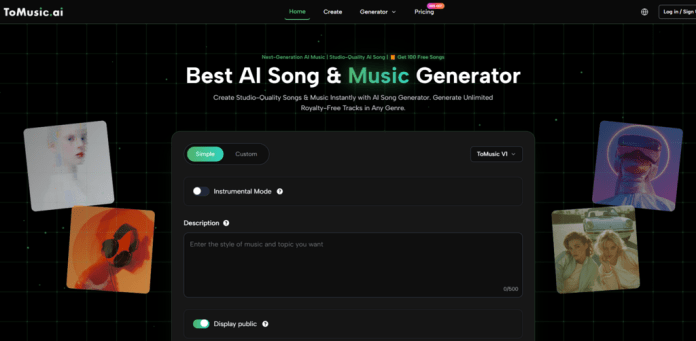
On the generator page, the user can enter a title, style instructions, lyrics, and choose whether the song should be instrumental. That sounds simple, but it matters deeply for lyric writers. It allows the words to remain part of the earliest creative instruction instead of being layered on top of a finished backing track later.
Style Controls Add Emotional Context To The Words
Genre, mood, voice, and tempo categories also help lyricists control interpretation. The same lyric can sound intimate in soft pop, tense in dark electronic production, expansive in cinematic form, or playful in a brighter setting. These controls let the writer explore what the lyric wants to become.
The First Generation Reveals Structural Truth Quickly
Once the user generates the song, the lyric is finally heard in context. This is where the platform becomes genuinely useful. It is no longer about abstract possibility. The writer can hear whether the chorus lands, whether the verse feels overcrowded, and whether the emotional pacing holds together.
The Official Creation Flow Keeps Songwriters Moving
A lyric-based tool should not slow the writer down with unnecessary complexity. ToMusic AI keeps the process compact.
Step One Starts With The Core Song Idea
The user enters the title, style guidance, and the lyric itself. This lets the writing remain central and avoids an awkward transition into technical production mode.
Step Two Shapes The Performance Direction
The user then refines the request through genre, mood, voice, and tempo choices. These are highly valuable for lyric-first songwriting because wording often changes meaning depending on performance style.
Step Three Generates A Draft Song Around The Words
The platform then produces the actual musical output. That is the moment when the lyric stops being private writing and becomes something the songwriter can evaluate as a song.
Step Four Saves The Result For Comparison And Revision
Generated tracks are stored in the user’s studio or music library. This is important because lyric-driven work often improves through side-by-side comparison. Writers need to hear multiple versions to understand which setting best supports the words.
Why Multiple Models Matter For Lyric Writers
Not all songs need the same interpretive strengths. The platform’s model structure reflects that reality.
The Best Music Generator For Lyrics Should Offer Different Voices Of Interpretation
ToMusic AI presents four models: V4, V3, V2, and V1. That matters because lyrics are not uniform. A sparse confessional piece, a harmony-led chorus, a long reflective composition, and a quick demo draft all ask for different treatment.
V4 Feels Aligned With Vocal Emotionality
The platform’s description of V4 emphasizes stronger vocal expression and deeper control. For lyric writers, this is often the most critical factor. If the words are central, then vocal delivery needs to carry more than pitch. It needs to carry intention.
V3 Supports Richer Harmonic Framing
Some lyrics benefit from a fuller harmonic environment because the words themselves are simple and need musical expansion around them. V3’s positioning around richer harmonies can support that kind of writing.
V2 Serves Songs That Need More Space
Longer lyrical forms can feel cramped in short musical structures. The site’s emphasis on longer compositions through V2 suggests a useful option for narrative writing, reflective material, or slower-building pieces.
V1 Helps With Fast Testing And Sketching
A balanced model still matters. Sometimes the lyricist does not need the most detailed result yet. They simply need to hear whether the core idea has musical life.
Where Text to Music Expands Songwriting Possibility
The phrase Text to Music is especially relevant to lyric-based work because it treats words not as metadata but as creative input capable of shaping the song itself. That is a meaningful redefinition of workflow.
For lyricists, this means the path from notebook to draft song becomes much shorter. The writer can test what a chorus sounds like when sung softly, what a verse does in a faster tempo, or how a bridge changes meaning when the arrangement becomes more spacious. These experiments are not decorative. They are part of discovering the song’s identity.
How Lyric Writers Can Use The Platform More Intelligently
A strong system still works best when the user approaches it intentionally. Lyric-first creators can get more from the platform by treating it as a conversation rather than a vending machine.
Describe The Emotional Job Of The Song
Instead of only naming a genre, it helps to describe what the song should emotionally do. Should it feel like release, memory, confrontation, comfort, temptation, healing, or private confession? That gives the system more meaningful direction.
Use Tempo And Voice Choices To Test Meaning
A lyric can become almost a different song under a different performance attitude. A more intimate voice may reveal vulnerability. A brighter one may reduce gravity. A slower tempo may deepen reflection, while a quicker one may expose which lines are too dense.
Accept Regeneration As Part Of Writing
The platform is most credible when used iteratively. A first generation may reveal that the second verse is too crowded or that the chorus needs fewer syllables. This is not a failure of the system. It is the normal discovery process of songwriting.
Where The Platform Fits Beyond Personal Song Drafts
Lyric-centered music creation is not only for aspiring songwriters. The use cases are broader than that.
Content Creators Can Build Message Led Songs
A creator may need a short lyrical hook for a campaign, social concept, or thematic video. A lyric-first workflow makes that possible without a long musical detour.
Educators Can Turn Language Into Memorability
Songs can help with retention, repetition, and emotional engagement in educational settings. If the words are already written around a lesson or theme, a system like this can help them become more memorable.
Personal Projects Gain Emotional Directness
There are also intimate use cases that matter: gifts, personal reflections, experimental writing, or songs created for moments rather than markets. Lyric-first generation supports these because the writer can keep emotional meaning at the center.
A Practical Comparison Of What Supports Lyric Based Creation
| Songwriting Need | What ToMusic AI Provides | Why It Helps |
| Starting from words | Direct lyric input in the creation flow | Keeps writing central instead of secondary |
| Emotional shaping | Genre, mood, voice, tempo controls | Lets the writer test different interpretations |
| Draft creation | Fast song generation from lyrical prompts | Provides immediate structural feedback |
| Model options | V1, V2, V3, V4 | Matches different lyrical goals to different strengths |
| Iterative writing | Regeneration and prompt refinement | Turns revision into part of the songwriting process |
| Draft management | Saved tracks in studio and library | Supports comparison across multiple lyrical versions |
Why Commercial And Practical Use Still Matter Here
Even lyric-first songwriting does not exist only in an artistic vacuum. Many songs are written to support broader communication goals.
Writers Increasingly Need Music In Production Contexts
A lyric can belong to a social campaign, a community project, an educational product, a podcast identity, or a brand experiment. The usefulness of a platform increases when song drafts can move beyond private testing into practical application.
Small Teams Benefit From Faster Song Prototyping
Teams that work with words but not always with composers can still explore lyrical song concepts internally. That speeds up review and idea testing before larger production commitments are made.
The Limits Should Stay Visible
A balanced evaluation should say clearly where the platform still depends on the human writer.
The Best Results Still Need Good Writing
A weak lyric will not become profound simply because it is generated into song. The platform can help reveal potential, but it cannot fully invent emotional depth where it is missing.
Some Songs Need Several Generations To Find The Right Form
That is especially true for lyric-heavy material. A phrase that looks elegant on the page may feel rhythmically awkward once sung. Multiple passes are often part of discovering what the song actually wants.
Human Editing Remains Part Of Serious Songwriting
The platform can accelerate drafting, but the writer still needs to revise words, remove clutter, tighten phrasing, and decide what emotional truth the song should keep.
Why ToMusic AI Works So Well For Lyrics First Creation
ToMusic AI stands out as one of the best music generator experiences for lyric-first users because it respects the natural order in which many songs begin. It lets words come first, offers musical controls that shape interpretation rather than overwhelm it, supports multiple model strengths, and makes iteration simple enough that writers can keep refining without losing momentum.
That combination is what matters most. A lyric is fragile in its early stage. It needs a fast way into sound so the writer can discover what is really there. When a platform helps that happen, it is doing more than generating music. It is helping language become song before the original feeling disappears. For lyric-centered creators, that is a meaningful advantage and a compelling reason to take the platform seriously.