

We live in an era where work and personal life are no longer tethered to a physical desk. The rise of multi-device ecosystems, comprising high-performance laptops, tablets, flagship smartphones, and wearable gadgets, has transformed our daily routines. However, this unmatched mobility introduces a familiar modern problem: the constant search for power.
In 2026, mobile energy requirements have grown drastically:
- AI & Performance Drain: Resource-heavy demands of local generative AI applications running on laptops, paired with high-brightness adaptive screens and advanced multi-core processors, drain lithium-ion batteries faster than ever before.
- The Shift in Hardware Needs: Gone are the days when a cheap, pocket-sized external battery pack was enough for an evening commute. Today’s tech landscape requires hardware that can serve as a dependable, mobile power workstation capable of running multiple high-wattage devices simultaneously.
Navigating the crowded market can be overwhelming due to confusing technical jargon and exaggerated marketing. To make the right investment, you only need to focus on three core pillars.
Pillar 1: Demystifying Capacity: Wh vs. mAh and Airline Compliance
The most common mistake when shopping for a power bank is relying solely on the milliampere-hour (mAh) rating printed on the box.
The Reality Check: Consumers often assume a 20,000mAh battery pack can fully charge a 5,000mAh smartphone exactly four times. In the real world, this math is fundamentally flawed due to electrical resistance and voltage conversion efficiency losses.
The Math Behind True Energy Output
Battery cells naturally operate at a nominal voltage of 3.7V. However, standard USB charging interfaces must output power at higher levels ($$5\text{V$$, $$9\text{V$$, $$15\text{V$$, or $$20\text{V$$). When converting its internal cell voltage to meet external demand, energy is lost as heat.
The true measure of a power bank’s total storage capacity is Watt-hours ($$\text{Wh$$), which accounts for both voltage and current:
$$\text{Wh} = \frac{\text{mAh} \times \text{V}}{1000}$$
When calculating the actual power delivered to your device, you must factor in a conversion efficiency multiplier (ranging from 0.7 to 0.8 in high-quality electronics):
$$\text{Actual Delivered Energy} = \text{Wh} \times \text{Efficiency Rate}$$
The Critical Legal Limit: Airline Compliance
Understanding Watt-hours is vital for travel safety compliance. The FAA and international aviation authorities (such as EASA and CAAC) strictly enforce a 100Wh limit for lithium-ion batteries in carry-on baggage without prior airline approval.
Any portable charger exceeding this limit risks being confiscated at airport security checkpoints. Therefore, the sweet spot for frequent flyers is a device designed to maximize capacity right up to that legal ceiling, offering around 99.x Wh of total energy.
Pillar 2: Total Power Architecture: Wattage and Multi-Device Management
Capacity tells you how long a power bank can supply electricity, but power output (measured in Watts) dictates which devices it can actually run and how fast it can charge them.
The Necessity of High-Wattage Delivery
Modern laptops require significant energy inputs to charge efficiently under heavy computing loads. If a power bank maxes out at a standard $$30\text{W$$ or $$65\text{W$$ output, a premium laptop running intensive tasks will still experience battery drain.
For a portable charger to truly serve as an on-the-go workstation power source, it must support high-wattage single-port delivery, ideally reaching 140W or higher, to match the charging speeds of standard AC wall adapters.
Dynamic Multi-Port Power Allocation
High-end power banks are measured by their multi-port power allocation. Many low-cost multi-port chargers use cheap internal circuits that drastically cut output speeds across all ports the moment a second device is plugged in (e.g., a “100W” port dropping down to a sluggish $$15\text{W$$).
Advanced power banks utilize smart, dynamic power management systems that:
- Monitor the power needs of every connected device in real-time.
- Safely shift and distribute the total wattage across all available ports.
- Ensure a laptop, a tablet, and a smartphone can all fast-charge simultaneously without slowing down.
Pillar 3: Safety and Longevity Checklist
Beyond capacity and output power, long-term reliability should be an important part of any power bank purchase decision. A well-designed power bank should not only charge devices quickly but also manage heat, monitor battery health, and protect connected devices during everyday use.
Intelligent Temperature Management
Heat is one of the primary factors that affects lithium-ion battery longevity. Premium power banks often include active temperature monitoring systems that continuously track internal conditions and adjust charging behavior when necessary. This helps reduce thermal stress on both the power bank and connected devices.
Battery Protection Systems
Modern power banks should incorporate multiple layers of protection against common electrical risks, including overcharging, overheating, overcurrent conditions, and short circuits. These safeguards help improve reliability during both charging and discharging cycles.
Clear Power Monitoring
Real-time visibility can make a significant difference when traveling or working remotely. Features such as battery percentage displays, charging wattage indicators, and recharge-time estimates allow users to better manage their available power and avoid unexpected downtime.
Shopping Warning: Identifying Dangerous Power Banks
Be skeptical of unbranded online listings claiming impossible specifications, such as a “50,000mAh ultra-compact power bank” sold for twenty dollars. Genuine high-capacity configurations are limited by weight and volume constraints. If an online deal seems too good to be true, the product may use low-quality cells, lack proper protection systems, and present potential safety risks.
A Real-World Example: Anker Prime Power Bank (26K, 300W)
For power users who need high-performance mobile energy, the Anker Prime Power Bank (26K, 300W) stands out as a leading option in 2026. It packs massive capacity, extreme speed, and smart safety into a travel-ready design.
1. Capacity & Airline Readiness
- Massive 26,250mAh (99.75Wh) Capacity: Engineered to sustain an entire mobile workstation on the go, keeping power-hungry business laptops, pro-grade tablets, and smartphones running through long-haul flights or extended off-grid work sessions.
- 99.75Wh Energy Rating: Intentionally designed just under the strict 100Wh legal limit. It passes through airport security checkpoints worldwide without prior approval.
2. Massive 300W Combined Output
The device features a flexible 3-port layout (2×USB-C, 1×USB-A) built for both high-end laptops and legacy gear:
- 140W Single-Port Power: When paired with a compatible 5A USB-C cable, a single USB-C port can deliver up to 140W of output, sufficient to charge a MacBook Pro (M4 Pro) to 50% in approximately 27 minutes.
- Smart Power Allocation: When using all 3 ports at once, it intelligently manages a 300W total combined output (e.g., 140W + 140W + 20W). You can charge two laptops and a phone simultaneously without any throttling.
| Port Configuration Usage | USB-C 1 Port Output | USB-C 2 Port Output | USB-A Port Output | Total Combined Wattage |
|---|---|---|---|---|
| Single Port Dedicated Load | 140W Max | 140W Max | 65W Max | 140W max per single output |
| Dual Port Combined Load | 140W | 140W | — | 280W Combined |
| Three-Port Full Load | 140W | 140W | 20W | 300W Combined Max |
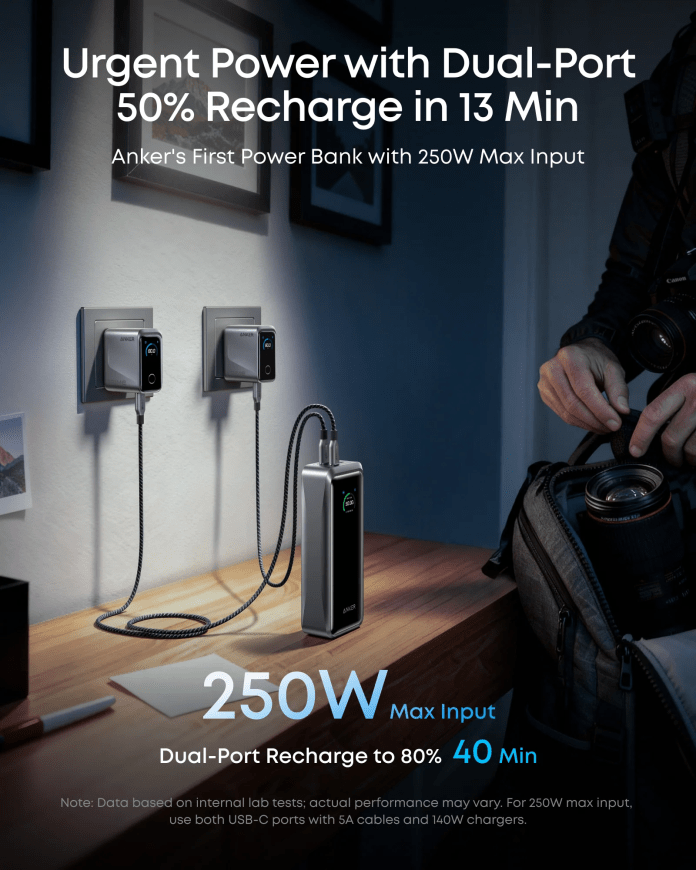
3. Revolutionary 250W Dual-Port Fast Recharging
No more waiting all night for your power bank to charge itself. By leveraging two charging ports simultaneously, you get ultra-fast refueling:
- To 50% Capacity: Only 13 Minutes
- To 80% Capacity: Only 40 Minutes
Real-World Scenario: Even during a brief airport layover or a quick coffee break, you can top off your portable energy ecosystem and be ready for hours of off-grid productivity.
4. Premium Control Interface & Active Safety
- Smart Digital Display: Shows remaining battery percentage, real-time power input/output wattages for every connected port, and estimated recharge times.
- ActiveShield 4.0 Safety: Monitors internal operating temperatures over 10 million times per day. It continuously cross-references thermal data to actively safeguard your connected devices from overcurrent, overvoltage, and overheating.
Conclusion: Choosing the Right Power Bank for Long-Term Value
Investing in a high-quality power bank means choosing a reliable device that keeps you productive and connected, wherever your work takes you. By looking past surface-level marketing and evaluating true capacity ($$\text{Wh$$), multi-port power distribution, and advanced safety systems, you can easily avoid low-quality or unsafe options.
Premium portable chargers like the Anker Prime Power Bank (26K, 300W) prove that high-performance mobile energy is no longer about compromise. It delivers maximum airline-compliant capacity, reliable multi-device power allocation, and advanced safety features, setting a high standard for portable charging technology in 2026. Prioritizing these design pillars ensures your mobile workstation stays powered safely and efficiently for years to come.