

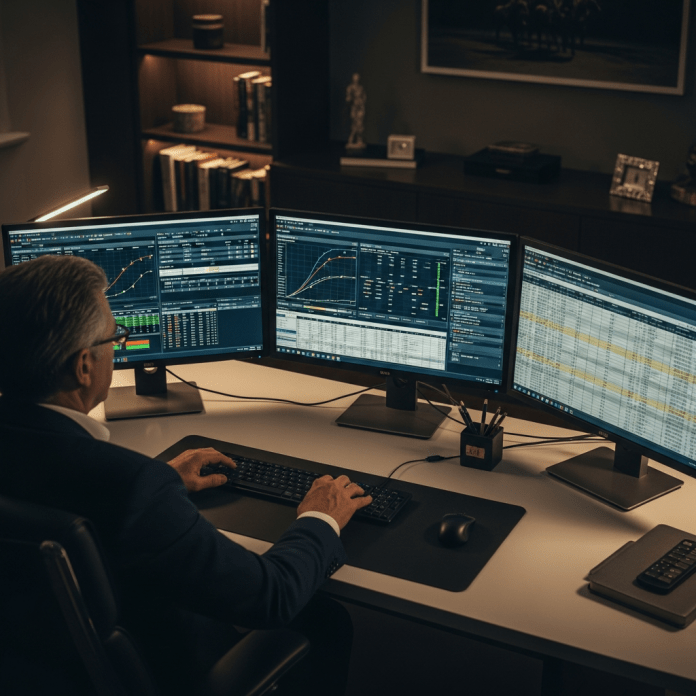
If you’ve spent any time in the high-stakes poker world over the last decade, you’ll know that the game has changed. It used to be about “feel,” reading the man across from you, and spotting a nervous twitch. Today, it’s about solvers, Game Theory Optimal (GTO) strategies, and cold, hard mathematics. But something interesting is happening. A lot of the sharpest minds I know in the poker community are starting to spend less time at the felt and more time looking at the morning’s racing cards.
It isn’t a random shift either. These players aren’t looking for a “vibe” at the track; they’re treating the turf like a giant, high-liquidity poker hand. The transition makes sense when you think about it. If you can master the complex branching trees of a poker solver, the variables of a horse race (ground conditions, draw bias, and sectional timings) just look like another set of data points to be crunched.
The Poker-to-Punter Pipeline: The Migration of Logic
Why are GTO specialists moving their bankrolls towards horse racing? The answer usually comes down to one thing: the “solved” nature of modern poker. At the highest levels of online play, the edges have become razor-thin. When everyone is playing a near-perfect mathematical strategy, the variance can be brutal. You might be the best player in the world, but if everyone else is 99% as good as you, your profit margins are slim.
Horse racing, however, is a different beast entirely. It’s an “unsolved” game. While there’s plenty of data available, the sheer number of external variables means the market is rarely perfectly efficient. For a poker pro used to fighting for 1% edges, the British racing markets look like a land of plenty. They’re taking the same rigorous bankroll management and statistical modelling they used to beat the nosebleed stakes at the poker table and applying them to the racing festivals.
I’ve spoken to a few guys who’ve made the jump, and they all say the same thing. They don’t care about the horses. They don’t even particularly care about the sport. What they care about is the “expected value” (EV). In poker, if you make a move that wins you money in the long run, even if you lose the hand, you’ve made a “plus EV” play. They’ve brought that exact mindset to the betting ring.
Algorithmic Arbitrage: Translating Pot Odds to the Turf
In poker, “range construction” is the art of figuring out every possible hand your opponent could have in a given situation. You don’t just put them on one hand; you put them on a distribution of hands. Interestingly, professional punters are now doing the same with race fields. Instead of trying to pick “the winner,” they are constructing a “range” for the entire race.
They ask themselves: “In 100 parallel universes where this race is run, how many times does Horse A win?” If the model says Horse A wins 25% of the time, but the bookies are offering 5/1 (which implies a 16.7% chance), they’ve found an overlay. That’s the same as getting the right pot odds to call a bet on the river with a flush draw.
It’s algorithmic arbitrage. These bettors aren’t trying to outsmart the trainer or the jockey; they’re trying to outsmart the market’s collective misunderstanding of probability. They use complex scripts to scrape historical data, looking for patterns that the casual fan might miss. Maybe a certain sire’s offspring perform 5% better than the market expects on “Good to Soft” ground, or perhaps a specific trainer’s strike rate at Ayr is statistically significant. When these small edges compound, the results can be massive.
Market Efficiency and the Grand National: Variance Reduction
When we talk about the big British racing festivals (think Cheltenham, Royal Ascot, or the Grand National), we’re talking about massive amounts of money entering the system. For a professional bettor, this liquidity is vital. If you’re trying to move five or six figures, you can’t do that at a small Wednesday evening meeting at Kempton without crashing the price.
The Grand National is a particularly fascinating case for the GTO-minded punter. Because it’s the one race the entire nation bets on, the market is flooded with “dumb money” from casual fans who pick horses based on names or silk colours. This creates enormous statistical noise. While the casual punter sees a chaotic 40-horse scramble, the pro sees a high-variance event where the prices often fail to reflect the true probability of a win.
Applying poker-style variance reduction here involves betting across multiple outcomes to “smooth out” the luck factor. In poker, you might play four tables at once to reduce the impact of one bad beat. In the Grand National, a pro might back five or six different horses that all represent value, effectively “buying” a large chunk of the field’s win probability.
Institutional Liquidity: Finding Each-Way Overlays
One of the most effective strategies used by the poker-turned-punter crowd is identifying “Each-Way” statistical overlays. This is where the maths of the place part of the bet is actually better than the maths of the win part. It’s a bit like finding a loophole in a poker tournament’s payout structure.
To execute this, you need access to real-time, professional-grade tools that can track price movements across the entire industry. Professionals need to be able to see where the liquidity is flowing and where the prices are out of sync. When you’re monitoring these shifts, having a reliable platform is essential. Many pros use the Bally Bet interface to keep an eye on horse racing markets, particularly for ante-post value where the odds haven’t yet adjusted to late-breaking news or weather changes.
Using these kinds of tools allows a bettor to see the “shape” of the market. For instance, in a race with a heavy favourite and a small field, the each-way terms for the second and third-ranked horses can often be mathematically in the player’s favour. It’s not about “cheating” the system; it’s about being the most informed person in the room and acting on that information before the rest of the market catches up.
Strategic Approaches to Long-Term Market Analysis
For someone who makes their living through high-stakes gambling, the goal isn’t just to win today; it’s to manage wealth over the long term. This is why many poker pros are diversifying their earnings into “ante-post” value models.
An ante-post bet is a wager placed weeks or months before a race takes place. It’s the horse racing equivalent of a long-term investment. By backing a horse for the Gold Cup in December at 20/1, when their model suggests the horse will likely be 8/1 by the time March rolls around, they are building equity.
It’s all about portfolio diversification. A poker player might have a certain amount of capital tied up in tournament buy-ins, some in cash games, and now, a significant portion in a “stable” of ante-post racing bets. This spreads the risk across different “asset classes” within the gambling world. If they have a bad month at the poker tables, a well-timed win at a racing festival can keep the bankroll healthy.
Staying Disciplined in a Numbers Game
The most important lesson these poker players bring to horse racing is emotional detachment. If you lose a hand because of a “bad beat” on the river, you don’t get angry; you just make sure you played the hand correctly according to the maths. The same goes for racing. If your horse gets blocked in the final furlong or loses by a nose, you don’t throw your remote at the telly. You look at your model, confirm that the bet was “plus EV,” and move on to the next race.
This cold, clinical approach is what separates the professionals from the people who just enjoy a flutter. It’s a job, a grind, and a constant search for a tiny percentage of value. As the worlds of high-stakes poker and sports betting continue to merge, we’re likely to see even more sophisticated models being used.
For the rest of us, it’s a reminder that the “luck of the draw” or the “luck of the turf” isn’t as random as it seems. There’s always someone, somewhere, with a spreadsheet and a solver, figuring out the odds.
***
Please remember to gamble responsibly. Betting should only ever be done with money you can afford to lose. If you feel like your gambling is becoming a problem, please seek help from organisations such as GamCare or BeGambleAware.