

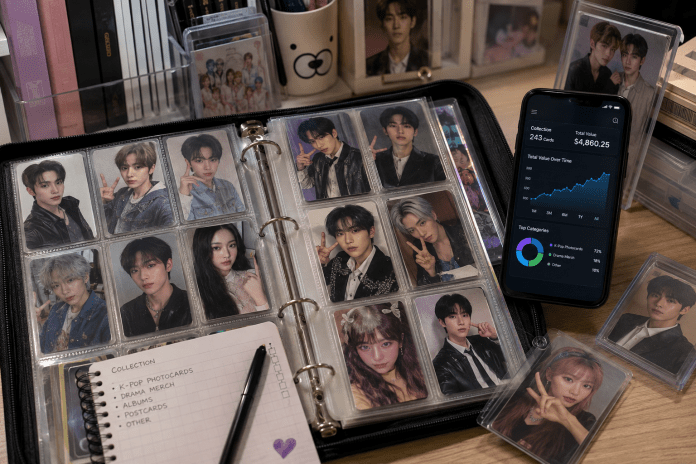
Most people who love Asian dramas end up owning cards. It starts with one photocard from an album, or a bromide picked up outside a Japanese theater, or a collab card from a Chinese drama promo set. A few years later there is a binder in the closet and nobody knows what any of it is worth.
That is the problem a trading card value tracker solves. It turns a pile of cards into a list with numbers attached, so you know what to insure, what to sell, and what you overpaid for. This guide explains how tracking works for drama and idol cards specifically, because they behave differently from Pokemon and sports cards.
What a trading card value tracker actually does
A tracker does three jobs. It catalogs what you own, it attaches a market price to each card, and it shows how that price moves over time.
The good ones pull from real sold listings rather than asking prices. This matters more than anything else. Sold listings show what buyers actually paid, while asking prices only show what sellers hope to get. A seller can list a common card at 300 dollars forever. That number means nothing until somebody pays it.
The better tools also log what you spent. If you bought a card at 40 dollars and it now trades at 90, a tracker shows the gap. Without that record you are guessing.
Why drama and idol cards are harder to price
Pokemon cards have set numbers printed on them. Drama and idol cards often do not.
K-pop photocards are small cards of roughly 55 by 85 millimeters, about the size of a credit card, randomly inserted into albums and merchandise, and the practice goes back to Girls’ Generation era albums in 2010. One album gives you one or two cards from a set that can run to dozens of versions. There is no catalog number to search.
Japanese drama merchandise adds another layer. Bromides, clear file cards and event cards are often sold only at one venue for one week. Chinese and Taiwanese drama collab cards from bubble tea chains or convenience store campaigns disappear just as fast.
So the first skill is identification. You need to know the group or actor, the exact release, the version, and the card type. A tracker is only as accurate as the card you tell it you own.
The four things that set the price
Card type and print run
This is the biggest factor. Regular album inclusions sit at the bottom. Standard album photocards usually resell for around 5 to 12 dollars, and their wide availability keeps prices steady, which makes them a fine starting point for new collectors.Pre-order benefit cards, known as POBs, are tied to a specific retailer and a limited pre-order window, so they get much harder to find after release.
Above those sit fansign cards, lucky draw cards and yearbook sets.
The numbers at the top are serious. The NCT 2020 Special Yearbook photocards were limited to 500 per member, and Taeyong’s version sold for 870.77 dollars, while one Chaeyoung card later sold for 1,324 dollars. Rare event-only or lucky draw cards of a popular member can reach anywhere from 500 to several thousand dollars.
Official or unofficial
Official cards come from the artist’s agency or label with licensed photos and proper copyright marks on the back, while fan-made cards, often called lomo cards, are made outside that supply chain and hold almost no resale value.
Plenty of new collectors log lomo cards in their tracker and end up with an inflated total. Check the back before you add anything.
Condition
Collectors are strict here. Even light edge whitening or a small bend can cut a card’s value by 30 to 50 percent.
That is why storage is not a side topic. Keep binders out of direct sunlight, since K-pop card stock fades faster than standard trading card stock. Sleeves and toploaders are expected, not optional.
Who is on the card
Demand follows attention. A drama airing now, a comeback week, an award, a military discharge, all of it moves prices. This is the part no tracker predicts for you. If you follow drama and music news closely, you already have an edge over the average buyer.
How to check a card’s value in five steps
- Identify the exact release, version and card type.
- Search sold listings, not active ones.
- Compare the same member, same type, same condition.
- Subtract shipping, platform fees and any proxy service cost.
- Ignore one strange outlier sale and take the middle of the range.
Prices are spread across eBay, Mercari, Bunjang and dedicated collector marketplaces, so a single site rarely gives you the full picture. Currency swings matter too, since much of the supply sits in Korea and Japan.
Tools worth your time
For idol cards, start with a K-pop specific price guide, because general databases usually do not catalog photocards at all.
For everything else in your collection, use a general tool. Card Ladder is built for portfolio and market tracking with historical price data and index style analytics, Collectr offers a clean interface across sports and trading card games though its pricing is estimate based, and CollX identifies cards against a database of more than 20 million with a free tier. If you collect Pokemon or sports cards alongside your drama merchandise, a general card value tracker will handle those sets properly while you keep photocards in a separate list.
Our own view after watching this hobby for years: treat any automatic total as a rough estimate. Verify anything above about 50 dollars by hand against recent sales. Tools are good at organizing and bad at judgment.
Fakes are the real risk in 2026
Authentication matters more each year as counterfeits increase. Reprints of expensive fansign cards are common and some are close to convincing in photos.
Check print texture, back-side text sharpness, corner cut quality and card thickness against a card you know is real. Ask sellers for a photo of the card next to a handwritten note with the date. Any seller refusing that on a high-value card is telling you something.
Mistakes that cost collectors money
- Pricing from emotion instead of comparable sales.
- Copying another seller’s overpriced listing as a reference point.
- Buying during a hype window right after a drama finale or comeback.
- Logging unofficial cards as if they carry value.
- Never updating the tracker, so the numbers reflect a market from two years ago.
FAQ
Do I need a trading card value tracker for a small collection? Under about 50 cards, a spreadsheet works. Past that, manual tracking falls apart.
Are drama merchandise cards worth as much as idol photocards? Usually less, because the collector base is smaller. Limited venue-exclusive items from popular series are the exception.
Should I grade my photocards? Rarely worth it. Grading suits standard trading cards. Photocard buyers care about honest photos and clean condition.
How often should I update values? Once a month is enough for most collections, and more often around a comeback or a big drama release.
The short version
A trading card value tracker will not tell you which card to buy. It tells you what you own, what it is worth today, and whether you are up or down. Combine that record with what you already know about which dramas and artists people are actually watching, and you are in a far better position than the average buyer refreshing listings at midnight.